Found the content on this page useful? Share it with your team!
SEO and AEO for AEC Firms: A Guide to Getting Found


Table of Contents
A developer needs an architect who has converted a warehouse before. A facilities director wants to renovate a hospital wing without closing it. A general contractor is putting a design-build team together and needs a civil engineer who knows the county.
If you’re an AEC firm pursuing these types of projects, you know that organic search is a critical part of the buyer journey. Fusion BD's second annual buyer survey, which polled the facilities VPs, plant operations directors and COOs who purchase AEC services, found that 66% use search engines six or more times a week to research providers, and 36% use AI tools to build an initial shortlist of firms.
SEO (search engine optimization) and AEO (answer engine optimization) are how firms earn their way into these consideration sets. For AEC firms, they are increasingly important parts of a credibility-led marketing strategy.
This guide covers how AEC buyers use search, which pages to build first, how to turn projects and people into evidence, how to publish expert answers, how to make your expertise easier for AI answer engines to interpret and cite, and how to measure progress. You should leave with a plan for helping your firm get found for the right work.
What are SEO and AEO in AEC marketing?
SEO is the work of getting your pages found and shown for the searches that matter to your firm. For an AEC firm, that might be "healthcare architects," "civil engineering firm Austin," or a question an owner asks before a project exists.
AEO is the same work, pointed at the systems that write answers instead of listing links: Google's AI Overviews, ChatGPT, Gemini, and Perplexity. You’ll also sometimes hear AEO referred to as generative engine optimization, or GEO.
Traditional SEO and AEO have a few important differences, which we’ll discuss below. They also have important similarities, and anyone who tells you AEO is a completely new discipline is not looking at the data or the documentation. Google, for instance, says in its own documentation that "there are no additional requirements to appear in AI Overviews or AI Mode, nor other special optimizations necessary."
More importantly, Google remains the dominant search surface. ChatGPT’s search-like prompts total about 12% of Google’s search volume, and many of the pages cited in the AI overviews come directly from Google’s traditional search results (although this number is falling). That makes the SEO work that earns your firm a place in Google’s results highly relevant to earning a place in its AI answers.
But AI Overviews are just one model. If you want to show up everywhere your buyers are searching, including ChatGPT, traditional SEO is not enough. We’ll discuss some strategies for doing just that later on, but let’s start with the fundamentals: getting your firm found by traditional search engines.
How search functions for AEC buyers
Hinge's 2022 study of nearly 300 AEC buyers found that asking peers for a recommendation and doing a web search remain the primary ways buyers search for information. But search functions differently for an AEC buyer than, say, the average consumer looking for a local architect or engineer.
The difference derives from how the work is awarded. Much public and institutional work, and a good share of private work, is won through qualifications-based selection. Typically, an owner issues an RFQ (or an RFP, and the difference matters), firms respond with an SOQ or an SF 330, a committee scores them against published criteria, a shortlist gets interviewed, and in federal A-E selection, fee is negotiated with the top-ranked firm afterwards.
Search as a whole, therefore, doesn’t just serve the function of getting firms found. There are several moments in the AEC buyer journey that touch it, including:
- Before the RFQ exists. The year or two during which an owner, a prime, or a program manager is working out who to invite.
- Between shortlist and interview. The evaluation check, when a committee member searches your people and your projects to corroborate what they already know about you.
- Inside an AI answer. When an owner asks an AI tool "which firms have designed occupied hospital renovations in the Pacific Northwest," it assembles a reply from whatever it can retrieve and verify.
Firms building out an SEO strategy, therefore, need to be thinking not just about capturing new opportunities, but about confirming qualifications to buyers that already know they exist.
The same journey shows up in traffic data from real AEC firms.
The shape of AEC traffic
If you want to understand what a good SEO strategy looks like for your firm, look no further than the top firms in your geography, sector or specialization. To illustrate this, we pulled the top organic keywords for 11 AEC firms. The figures are tool estimates, not a representative industry study, but the pattern is consistent across the sample. Here’s how the traffic broke down:
| Share of traffic | Type of search | Examples |
|---|---|---|
| 49% | Branded searches | "kimley horn", "dlr group", "martin & martin engineers" |
| 43% | Non-branded searches for named projects or places | "pinnacle bank arena lincoln ne", "renwick gallery", "dirksen federal building chicago" |
| 2.9% | Searches for a firm to hire | "civil engineering companies near me", "mep chicago", "structural engineers fort collins" |
Explainer articles also generated traffic, but most of the firms we looked at did not have a dedicated content strategy targeting educational queries.
Learning content should be part of your firm’s organic search strategy when search volume, BD conversations, or recurring client questions show buyers need help with the topic. But, like the top firms we analyzed, you should prioritize keywords and pages that drive revenue first.
Build your search strategy around how clients evaluate firms
Every great SEO strategy starts from your ideal customer and asks the same question: what would he/she be searching for? Optimizing your website and content for these queries is the surest way to drive revenue from SEO rather than rankings and vanity traffic.
For AEC firms specifically, that means taking a hint from the traffic breakdown above and starting at the intersection of service, project type, place, and the problem your buyer has.
Recurring problems and questions your buyers ask make excellent kindling for keyword research. They also double as a citation opportunity in AI search: the questions your buyers ask you are often the same ones they ask Claude, ChatGPT, Perplexity, and the like when they’re evaluating firms and looking for solutions.
Where do you find these questions? Start by asking the people who hear them: principals, project managers, and business development. Which inquiries were worth taking? Which pursuits were lost, and what questions did the owner have before the RFQ went out?
When creating your keyword list to prioritize content, pay close attention to search volume and keyword difficulty, as these metrics determine how much demand exists for your services, and how easy or challenging it is to rank for a given keyword. More importantly, though, pay attention to intent, because commercial intent queries (“structural engineering firm Denver”) are often worth more in near-term revenue than informational queries (“what affects warehouse site development costs”).
To be clear: you should address both kinds of intent, but choose the right format for each: a service page, a sector page, an article or an FAQ answer. Ranking for commercial intent keywords drives revenue opportunities. Ranking for informational queries drives traffic and primes the funnel.
| Buyer intent | Example search | The page that answers it |
|---|---|---|
| Find a provider | structural engineering firm Denver | The service or office page for that discipline and place |
| Find sector experience | architects for occupied hospital renovations | The healthcare sector page |
| Investigate a problem | what affects warehouse site development costs | An expert planning guide, written by the engineer who gets asked |
| Evaluate a firm | [your firm] school renovation projects | A project case study with the facts a committee needs |
Also, consider the nuances of your specific buyer. High-volume keywords like "architect near me" (~4,800 searches a month, Ahrefs US, October 2026) might look appealing because of the search volume, but "commercial architect near me" will drive higher-value prospects to your site.
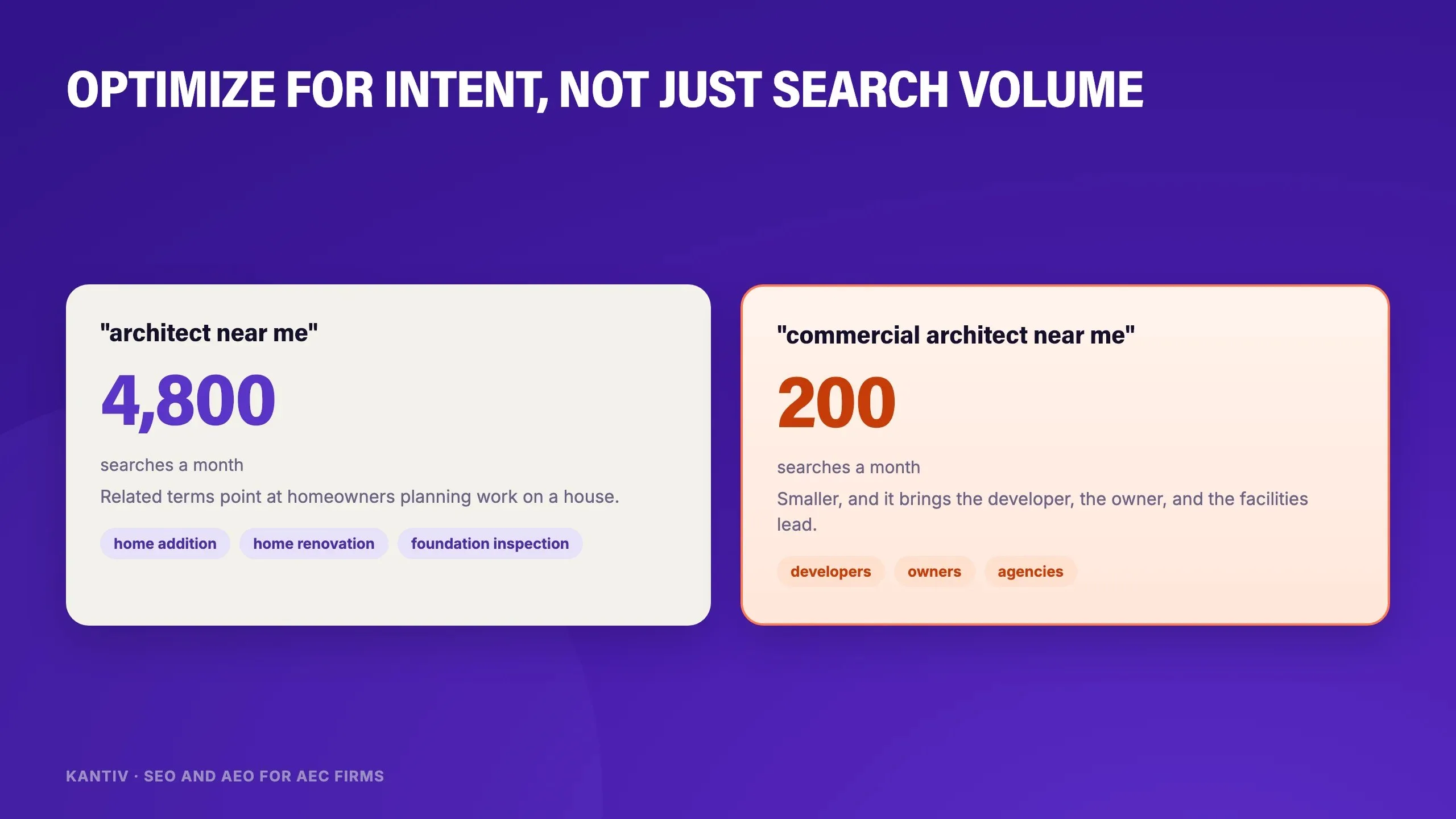
To be clear: a broad head term with a ton of search volume may include some of your buyers, so review the search results before deciding whether it reflects the work your firm actually wants. But it’s worth quantifying just how much before deciding how to position your on-page copy and meta tags.
Give each priority service and sector a useful home on your website
Once you’ve mapped the demand that is most relevant to your firm, you need the content to capture it. As we mentioned earlier, informational articles are great, and can drive valuable traffic for your firm. But first and foremost, buyers need to know what your firm does and why it's qualified. This is the job of your service and sector pages.
If your firm’s website doesn’t have much domain authority, don’t sweat it. Many specific high-intent AEC queries are more winnable than firms assume, and in many cases, Google rewards pages with useful and relevant content before it rewards authority.
Consider a query like "commercial architects dallas." Google ranks three sites with domain ratings below 30 in the top 10 (Ahrefs domain rating, Google US, October 2026).
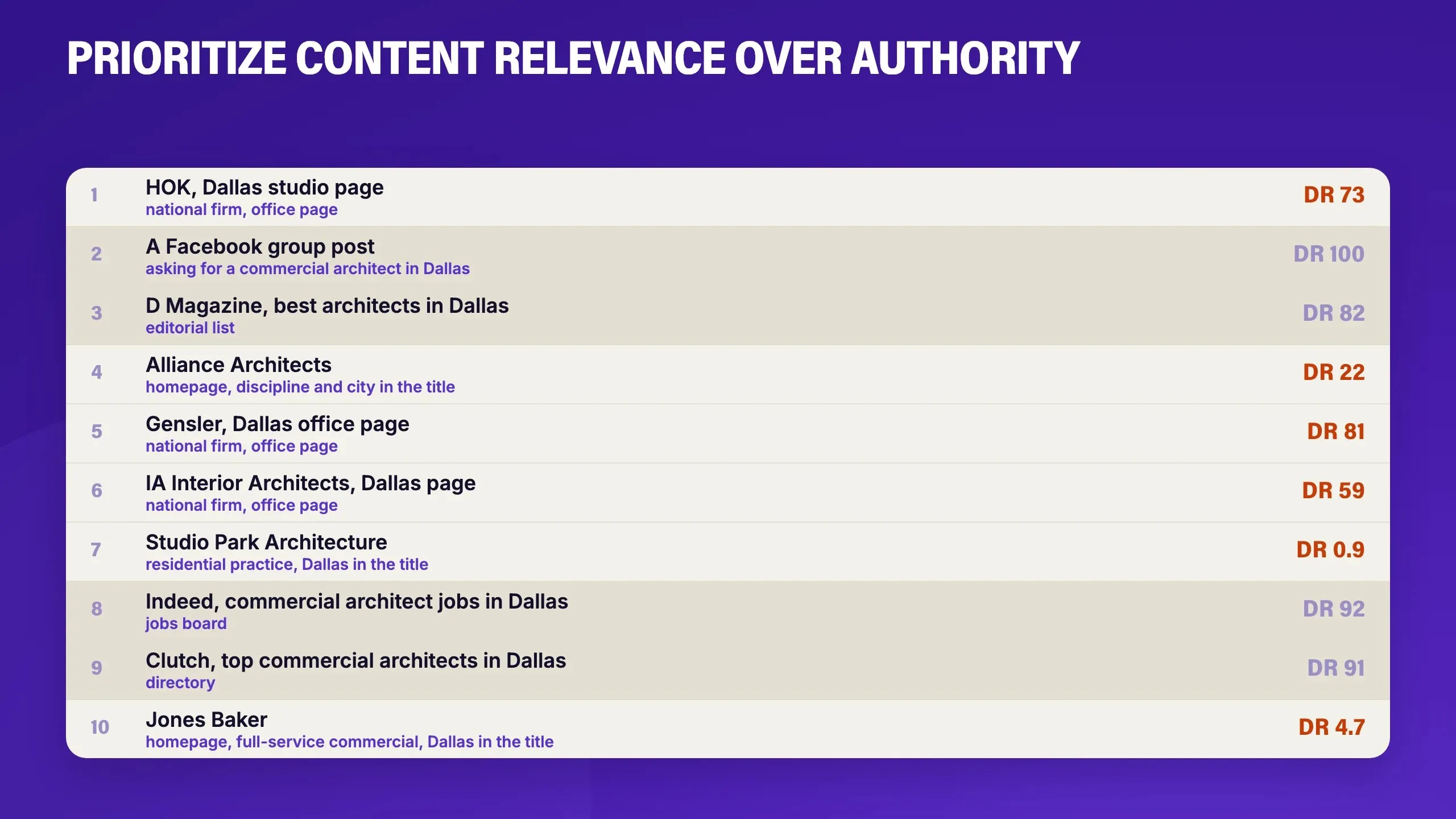
The quantity and quality of your inbound links are important, but content relevance and usefulness define who ranks and who doesn’t. The search results prove this truth time and again.
On the note of relevance: notice what the ranking firms all have in their titles and URLs. They each name the discipline and the place, then serve a page that delivers on both. Google's own guidance asks for exactly that: a title that is "unique to the page, clear and concise, and accurately describes the contents."
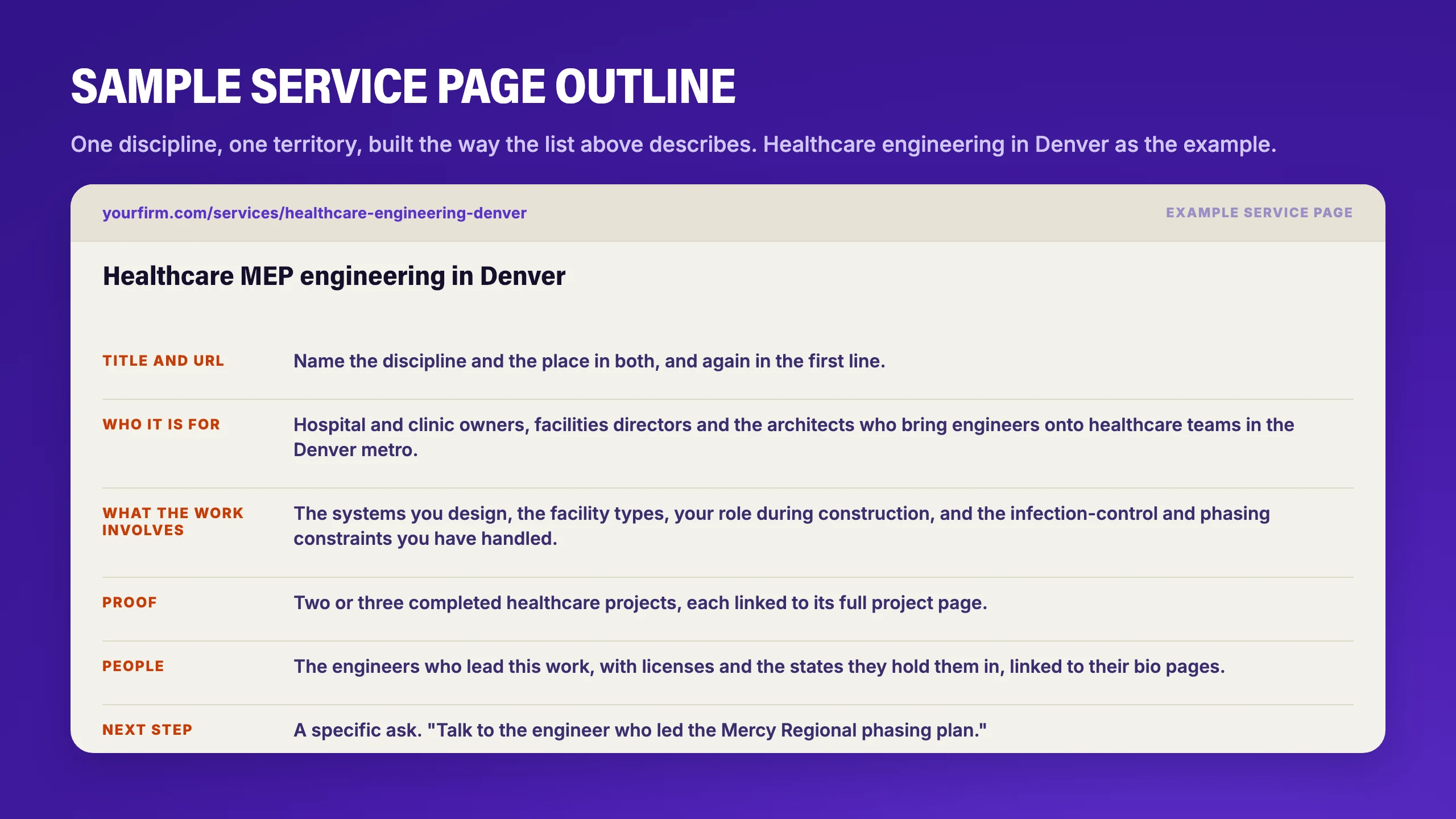
As a best practice, build your service and sector pages like this:
- One page per discipline and territory you genuinely serve.
- Name the discipline and the place in the title, the URL and the first line.
- Fill it with what a practitioner in that sector would know. For healthcare engineering, that might mean the systems you work on, the facility types, your role during construction, the infection-control and phasing constraints you have handled, the named people who lead the work and their licenses, and the states you cover.
- Prove it with two or three completed projects, each linked to its full write-up.
- End with a specific next step. "Talk to the engineer who led the Mercy Regional phasing plan."
💡Pro tip: Make your service content as comprehensive and useful as the capability statement you’d send, and you’ll be in good shape.
Use project pages as evidence of your capabilities
Project galleries show what the finished building looks like, which is great. But your case studies and project pages need to go deeper.
In an AEC SEO strategy, detailed project pages help potential buyers confirm your firm is qualified. They also attract search traffic, especially for named projects, places or unusual project types; but the bigger value is increased conversion among the small percentage of that traffic that is your buyer.
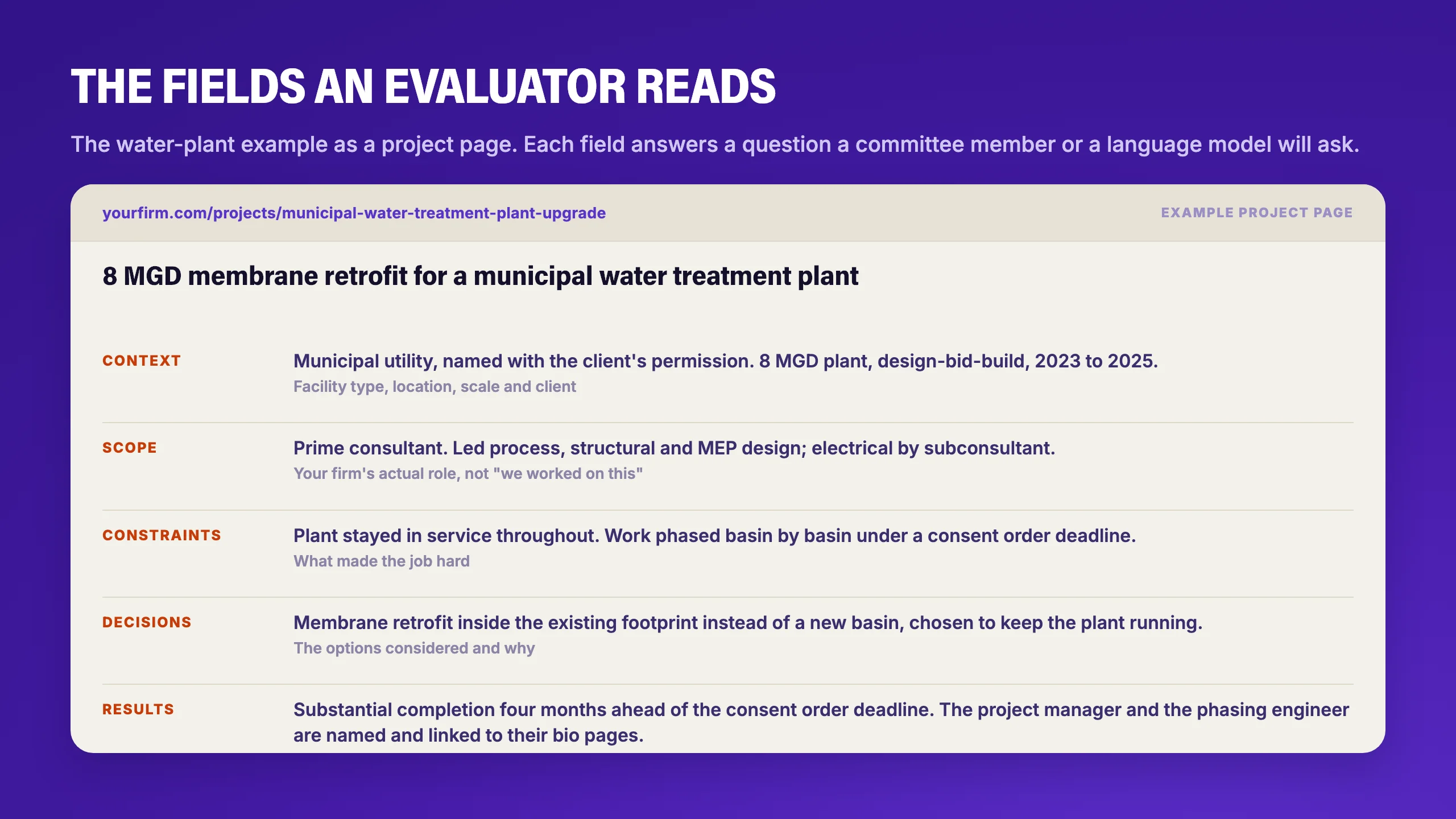
Let's use an example. A portfolio entry like "municipal water treatment upgrade" tells your buyer what kind of project your firm worked on, but it doesn’t give them enough to judge whether that experience fits their needs. It becomes evidence when it includes specifics they can check: things like the plant's capacity, how construction was phased to keep it running, and which engineers planned that phasing.
For each project that proves a sector or a service, write down five things:
- Context. Facility type, location, scale, and the client where you have permission to name them. Before any of it goes public, confirm the client's permission, strip confidential or procurement-sensitive detail, and have the technical lead verify scope, dates, roles and outcomes.
- Scope. Your firm's actual role. "We worked on this" and "we were the prime and led structural and MEP" read very differently to an evaluator. Which one is on your page right now?
- Constraints. Occupied space, limited access, existing conditions, the consent order, the academic calendar.
- Decisions. The options considered and why the team chose the approach it did.
- Results. Verified outcomes, kept separate from targets. Substantial completion four months ahead of the deadline is a result. "On track to deliver savings" is a hope.
For an occupied hospital renovation, for instance, that might mean highlighting how phasing and shutdowns were coordinated. For adaptive reuse, it might mean showing how the existing structure shaped the design.
Your project page's job is to succinctly confirm that you have done a given kind of work, under a given set of constraints, with a given set of results. Then, hand the reader a next step. This not only acts as evidence to your buyer, it also gives the AI models evidence to retrieve and cite when a buyer asks which firms have done this kind of work in their market.
💡Pro tip: Your website content and proposals often draw from the same sources: project histories, specialist experience, and technical narratives. Kantiv makes that underlying knowledge accessible and reusable, so page updates and proposal drafts can start from the same record.
Make your people findable
In qualifications-based work, the firm is evaluated through the people it proposes. The RFQ asks for a named project manager. The committee scores the key personnel. The interview is a room full of your people.
So, the evaluation check is often run on names. The principal who signed the cover letter gets searched. So does the PM. What comes back is typically a bio page, a LinkedIn profile, a conference listing, and maybe a quoted line in an ENR piece. If all those sources agree with each other and with the SOQ, your firm looks like what it claimed.
From an SEO perspective, every key person on your team should have a bio page on your website. Each page should include their licenses and the states where they’re licensed, projects they’ve led, sectors they serve, talks and publications, and a current photograph so selection committees can recognize them at the interview. Keep the underlying staff records in one place so bios, resumes, SOQs, and proposals draw from the same information.
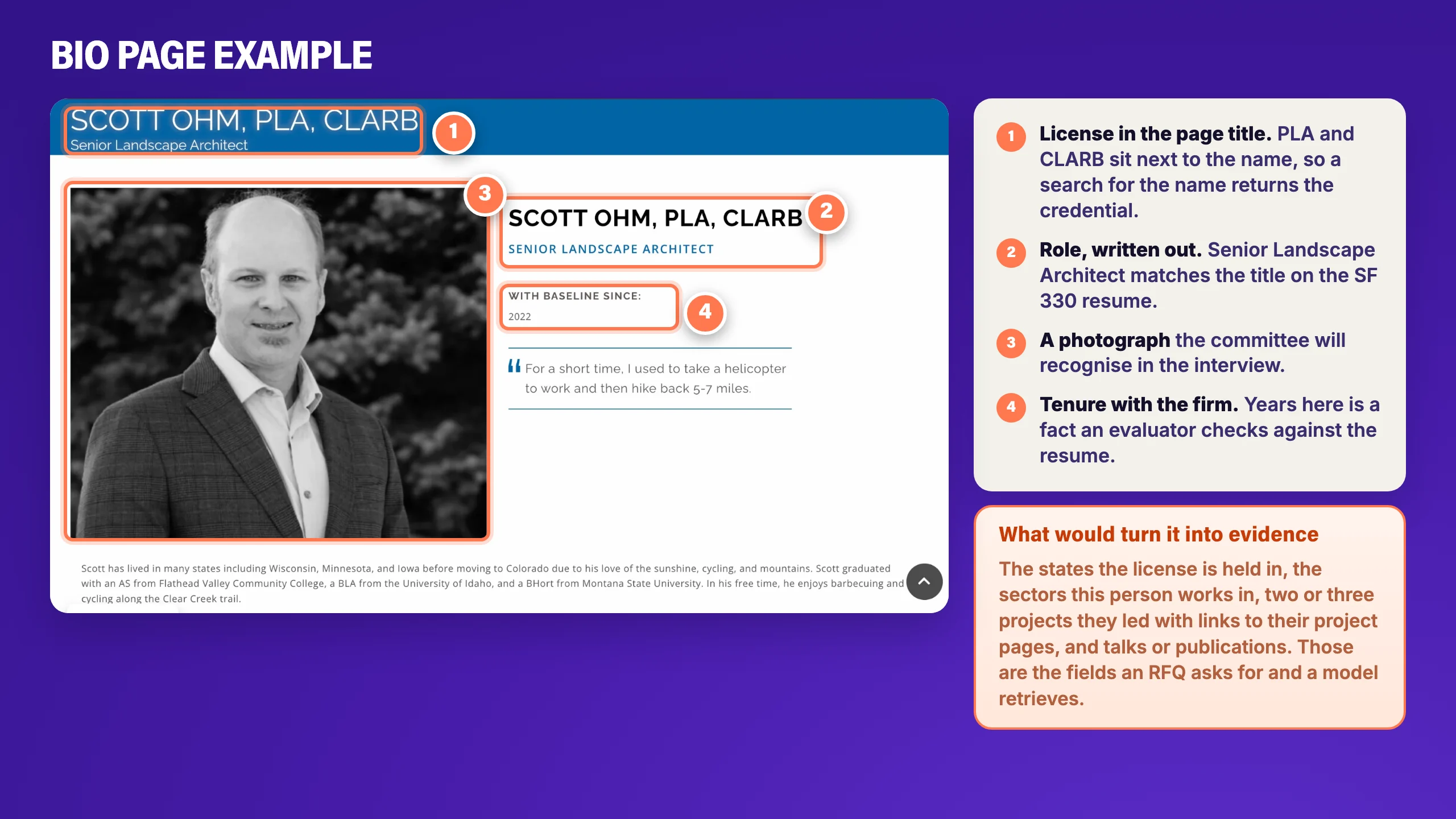
Keep the spelling of their name, their title and the firm name identical across the website, LinkedIn, and other sources AI models retrieve. That consistency helps search engines and AI systems connect those records to the same person.
Publish technical content that answers real client questions
We’ve talked a good deal about traditional SEO tactics thus far. Now, let’s get into the AEO layer.
Buyers use AI models differently than they use Google. Prompts are often longer and more conversational than a Google search, and resemble how the buyer would speak naturally. As such, your content plan should be a mixture of keywords that have measured search demand, and the questions your people answer on calls every week:
- What should an owner investigate before converting an office building to housing?
- What does a civil engineer need before site design can start?
- How does a school renovation get planned around the academic calendar?
- What causes scope to change during an existing-building assessment?
- What does a design-build team need from the owner in the first 30 days?
If a question or topic comes up on calls with your firm, it is a strong candidate for search and AI-facing content, even if keyword tools show little volume. It’s worth having standalone pages or content addressing these questions, or incorporating the answers as sections within content targeting measured keyword volume.
For each question, interview the person who has done the actual work. Ask what owners misunderstand, which conditions change the recommendation, and what happened on a real project. Those details are what a generic overview can't contain, and they're what models rely on to form answers in AI search.
Creating a 100 pages targeting 100 different recurring questions would obviously be a challenge for most firms, where often, the same person or people who write proposals are also in charge of marketing content.
If you want to make content production easier, start from the kernel of what your firm already owns. Past SOQs and proposals often contain useful technical narratives, approach language, and project descriptions that subject-matter experts helped shape. Strip the client-specific and confidential material, remove anything an owner asked you not to publish, and the approach narrative from last year's submission may hold the seed of this year's expert article.
💡Pro tip: Kantiv's chat can gather project references across your firm's uploaded pursuits and let you check the source PDFs. One customer's marketing lead used those details to draft a blog post and send it to the project team for review, with less research time. Benesch, a Kantiv customer, uses Kantiv for bios, collateral, and case studies as well as proposals.
Under each heading, be sure to answer the question directly before the exceptions and examples. Use a comparison or a checklist where it helps a reader decide. And always link to the relevant service page, project and bio.
Make your content easier for AI answer engines to lift and interpret
AI answer engines need text they can parse. That means that pages or sections of pages that directly answer a recurring buyer question should concisely and accurately answer said question, and do so as early as possible in the content.
Here’s how you can make your copy more liftable to give your pages a better chance of being cited by AI models:
- Use descriptive headings, concise definitions, and tables where a comparison helps.
- Make your firm identity, locations, services, and areas of expertise explicit on the page.
- Name authors and reviewers where it makes sense to earn credibility.
- Back claims with evidence, such as project examples, credentials, methods, awards, publications, or code experience.
- Use FAQs where readers have genuine questions.
The idea is to structure your content for AI as well as humans. There is a limit to how “retrievable” you can make your content without causing friction for readers, and content should, above all, be highly relevant and useful for humans. But AI models do reward clarity, consistency, and structure.
💡Pro tip: Kantiv’s Client Intelligence Agent tells your team what to emphasize based on what this client has responded to before, so you know before you draft. The Draft Analysis feature shows whether what you wrote lands the way you intended after you draft.
Earn the citations that buyers and models both read
We mentioned earlier that SEO and AEO differ critically. The single biggest difference is that AI models often assemble answers from third-party sources (i.e. not just your own website).
The offsite sources that matter most depend on your business and vertical. For AEC firms, this typically means making sure your firm shows up in places like:
- Association and chapter profiles at AIA, ACEC and SMPS
- ENR and Building Design+Construction rankings and project coverage
- Dodge Construction Network and The Blue Book Network listings
- Awards pages, university lecture listings, conference speaker pages
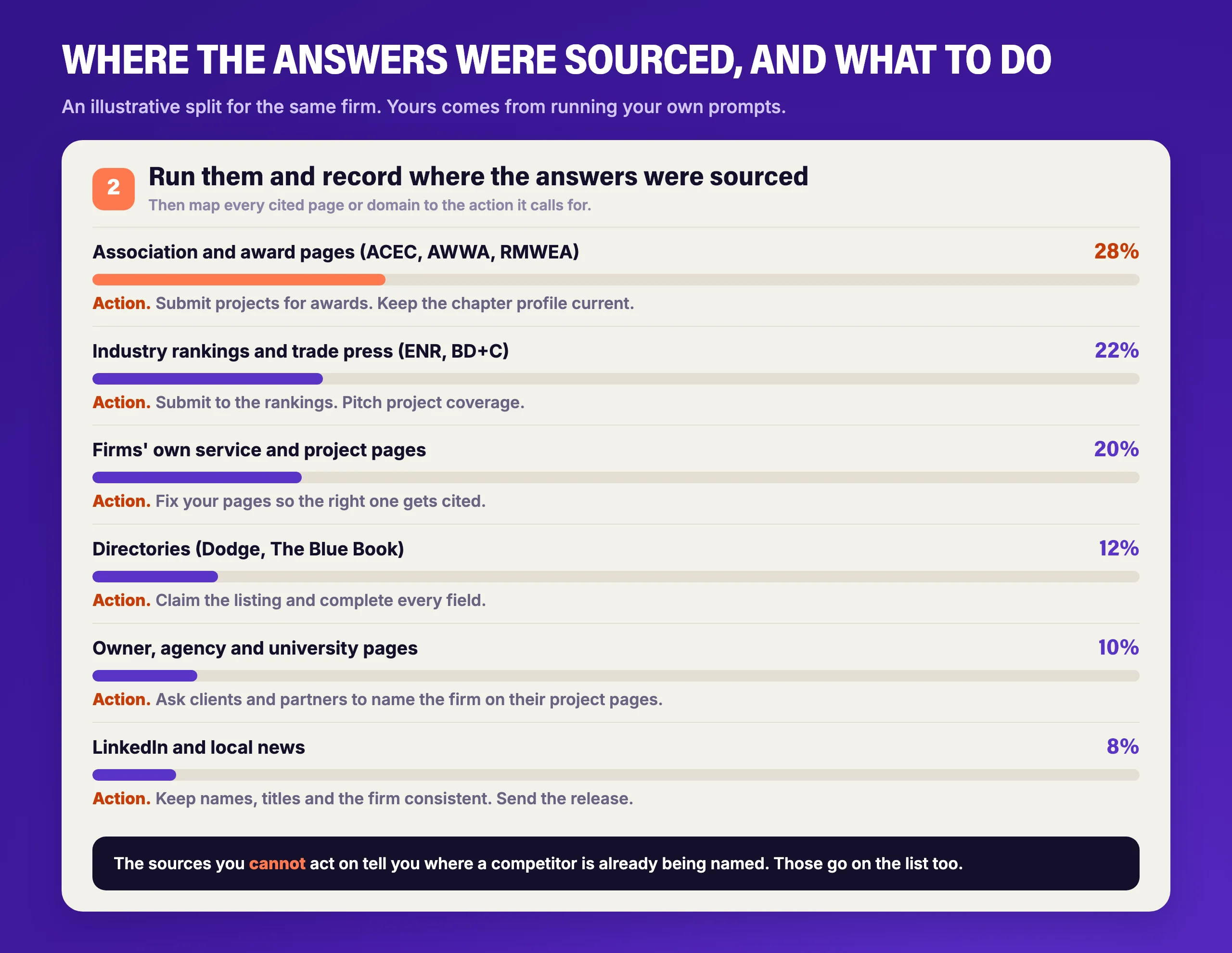
A good example: we asked ChatGPT for the best wastewater treatment design firms in Colorado. It named Carollo, Brown and Caldwell, and HDR, and sourced all three to the Rocky Mountain Water Environment Association's awards page.
We asked Perplexity the same question, and it sourced eight firms to an ENR list and the firms' own service pages.
AI answers lean on third-party sources over company websites. In Peec AI’s analysis of citations across five AI search systems, the 10 most-cited domains were all third-party platforms and publications. Showing up consistently across these trusted third-party sources helps AI systems reconcile your firm's services, locations and people.
How do you find the offsite sources that matter for your firm? Take your 20 highest-value questions and prompts, phrased the way a program manager would say aloud, and run them through a few different models. You can do this manually and log the results, or you can use a visibility tracker like Peec AI or Profound.
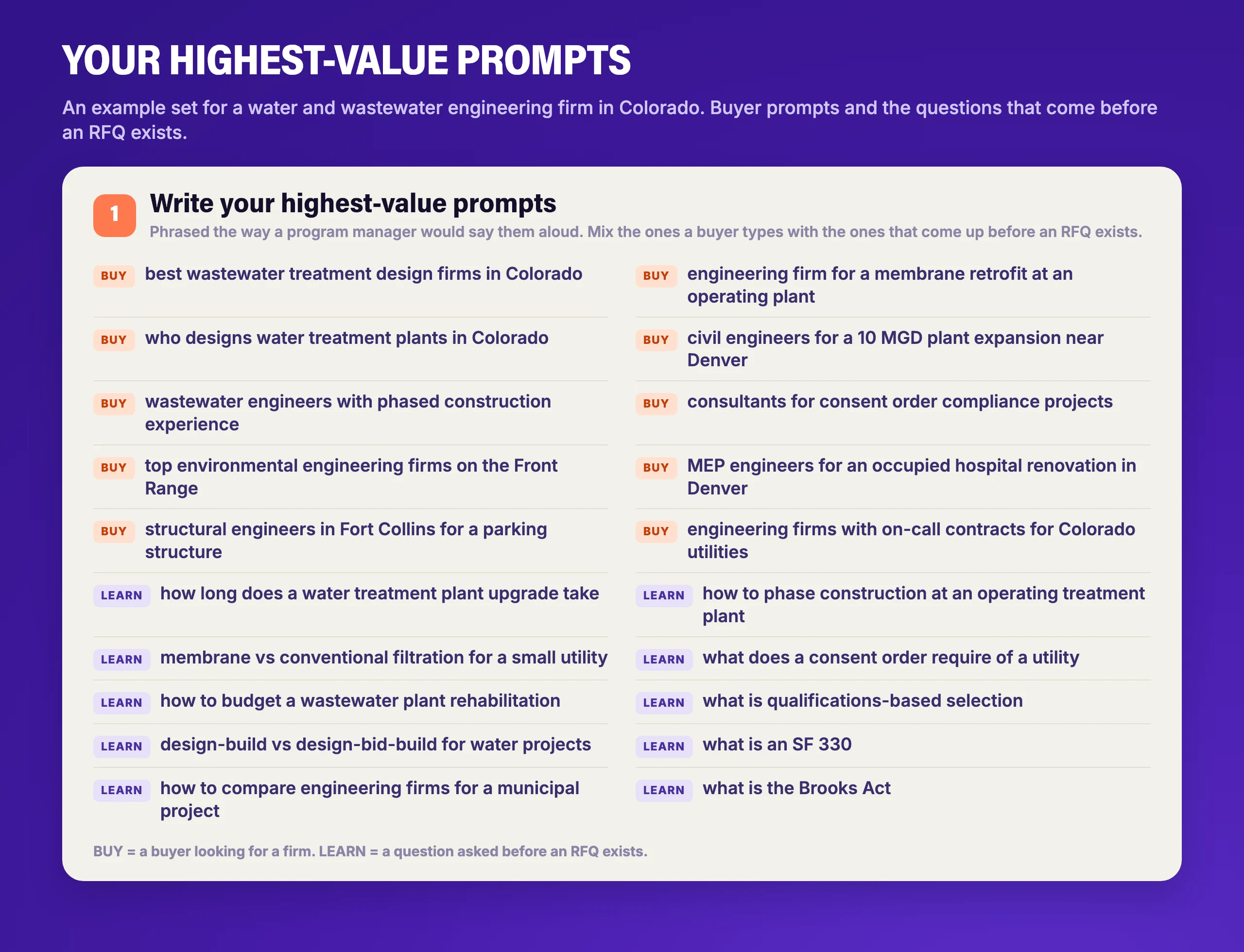
Then, for each prompt, look at what comes back and map every cited page or domain to an action. That might mean claiming a directory listing, submitting for an award, pitching a ranking or publication, asking for a mention on a client’s or partner’s project page, or fixing one of your own pages. Here’s an example of what that might look like:
How to measure SEO and AEO
The main metrics you should be tracking to measure SEO and AEO for your firm are:
| Level | What to track |
|---|---|
| Search visibility | Impressions and clicks on the terms you chose, with branded searches split from everything else, and the sector and service pages tracked as their own group |
| AI visibility | A fixed set of buyer prompts run monthly: whether the firm is mentioned, which pages are cited, how the firm is described, and whether the description is accurate |
| AI referrals | Referral traffic from ChatGPT, Perplexity, Gemini and Copilot in analytics, read cautiously because attribution is partial |
| Engagement | Project page views, bio views, relevant downloads, contact actions, inquiries |
| Business results | Qualified conversations, invitations to pursue, shortlists, and hit rate split by how the pursuit originated |
Measure a baseline in each metric to start, then repeat the same checks monthly. When tracking AI visibility, record the AI model, the date, the wording, the cited sources and whether the firm was actually recommended. Answers vary between runs, so treat the result as a directional sample.
Connect inquiries to the CRM and ask every prospect how they heard about you. Keep the first source and the later touches. A developer who heard your name at a conference, searched it, read two project pages, and called is a search-assisted opportunity that won’t show up cleanly in your analytics, but you should try to track nonetheless.
Start with the expertise your firm already has
Effective SEO and AEO help prospective clients discover your firm and understand why your team is qualified. Clear service pages, detailed project examples, and useful answers to buyer questions make your experience easier to find and evaluate.
Kantiv, formerly Joist AI, connects search content and proposals through the expertise behind both: project experience, staff knowledge, and technical narratives. It helps your marketing team find relevant material, use client and pursuit history as a starting point, and review whether a proposal communicates the positioning you intended. That means less manual gathering and assembly, with more time to choose the evidence and sharpen the message.
Book a demo, bring a live RFQ or RFP, and see how Kantiv can help your firm win more pursuits.
FAQs
Does SEO actually win AEC work when most revenue comes through RFQs?
The go/no-go decision is made on relationship, experience, and capacity, so search rarely wins AEC work by itself. Search feeds the consideration set before an RFQ exists, survives the evaluation check between shortlist and interview, and supplies the pages an AI answer cites.
What is the difference between SEO and AEO for AEC firms?
SEO is the work of being found and shown for the queries that matter to your firm. AEO points the same work at the systems that write answers instead of listing links, where being retrievable and cited by a model is the goal. The foundations overlap almost entirely; the difference is that AI answers lean on third-party sources, so AEO adds off-site work that classic SEO rarely required.
How much search volume exists for what my firm does?
Often a few hundred searches a month across every term that matters. "Healthcare architects" runs 350 a month, "multifamily architects dallas" runs 90 (Ahrefs US, October 2026). The searchers behind those terms can put you on the right lists. Score demand by pursuit value.
Do we need llms.txt or special schema to appear in AI Overviews?
Google states there are no additional requirements beyond being indexed and eligible for a snippet, and that eligibility does not guarantee inclusion. An llms.txt file is not required for Google's AI features; treat it as optional documentation, not a visibility lever. Add structured data only where it describes what is visibly on the page.
We have multiple offices. How many location pages should we build?
One per office that has a real team, real projects and real jurisdictions to describe. Google's doorway-page policy targets pages created to rank for similar queries that are less useful than the destination they lead to.