Found the content on this page useful? Share it with your team!
IDIQ Contracts in AEC: How They Work and How to Pursue Them


Table of Contents
If your AEC firm has ever won an IDIQ award, you know the feeling. A seat at the table, the prospect of multiyear work with one agency, and a contract ceiling with a lot of zeroes in it.
That ceiling can make an opportunity look irresistible. But the business case depends on the work your firm can realistically win and deliver underneath it. Your pursuit strategy needs to account for that work from the beginning.
For marketing and business development teams, that means planning beyond the initial selection. The qualifications that won the contract need to stay current as assignments change, staff move onto other projects, and new experience comes in. And the first task order notice may land before you’re done celebrating.
This guide covers how federal IDIQ contracts work, the differences between A-E services and construction, and how to prepare your team for the full life of the opportunity.
What is an IDIQ contract?
An indefinite delivery, indefinite quantity (IDIQ) contract lets a government agency order work as needs arise during a defined period. It sets the scope and the ordering terms, including a minimum commitment and a maximum quantity or value. The agency then issues task orders for individual assignments.
FAR 16.504 sets out the federal framework, and where multiple awards are contemplated, it requires the contract to state the procedures the agency will use to give awardees a fair opportunity to be considered for each order. As of October 2026, the FAR is being rewritten and many agencies have adopted revised versions of Part 16. Check the solicitation and the agency’s current rules before relying on specific section numbers.
For an engineering firm, for instance, that might mean a contract covering recurring facility assessments and design services, followed by task orders for particular buildings or sites. The agency sets up the arrangement before it knows every assignment it will need.
Confused? The terms are easier to follow once you separate the contract from the individual work:
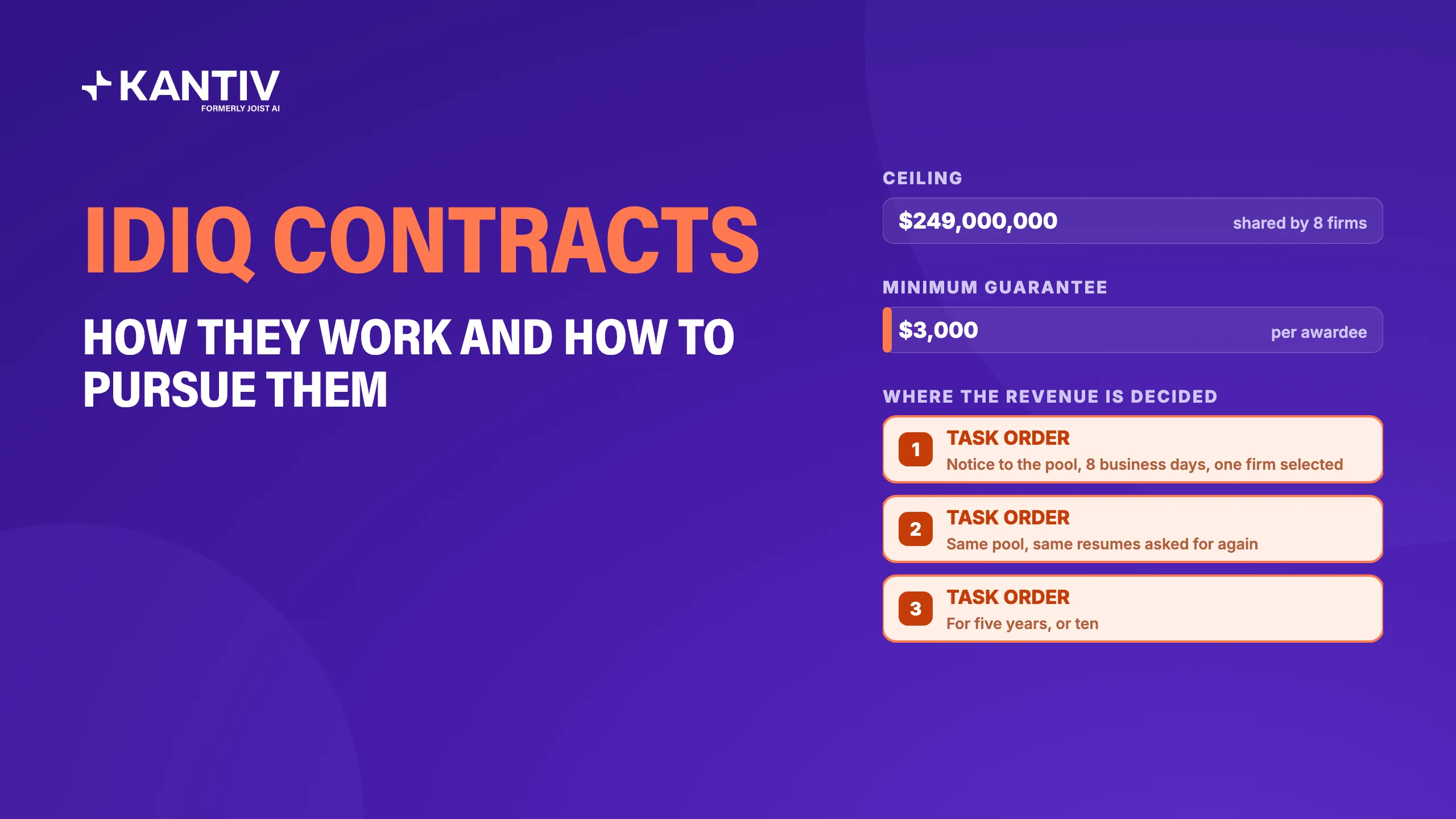
In practice, the minimum guarantee and the ceiling sit far apart. One example: when the Air Force announced its $1.5 billion environmental A-E IDIQ awards to 27 firms in February 2025, each awardee had $3,000 obligated at award.
The ceiling is a limit. The standard clause in every IDIQ says the quantities in the schedule are estimates only and are not purchased by the contract, so check whether an advertised figure applies to one contract or is shared across a group of awards before you use it in a pursuit assessment.
How do IDIQ contracts work in AEC?
IDIQs let agencies keep design, engineering, environmental or construction capabilities on call for recurring needs. How it works: First, your firm pursues the contract. Once awarded, the agency places task orders under the contract's ordering procedures, and your team performs the assignments it receives.
The resulting scale can be pretty significant. In July 2025, for instance, AECOM announced it had been selected for three USACE Honolulu District multi-award A-E IDIQ contracts with a combined ceiling of more than $400 million, covering architectural design, civil design and environmental planning.
We should also take a moment to distinguish between single-award and multiple-award IDIQs, because it changes what your team should expect after award.
Task orders are not handled the same way on every IDIQ. If one firm holds the contract, orders issued under that IDIQ go to that firm, subject to the contract terms and the agency's actual needs. If multiple firms hold awards under an IDIQ for services outside Brooks Act A-E selection, each firm usually gets a fair opportunity to compete, and price usually counts. If multiple firms hold awards for A-E services subject to qualifications-based selection, the agency typically selects the most qualified firm for each order, then negotiates the fee.
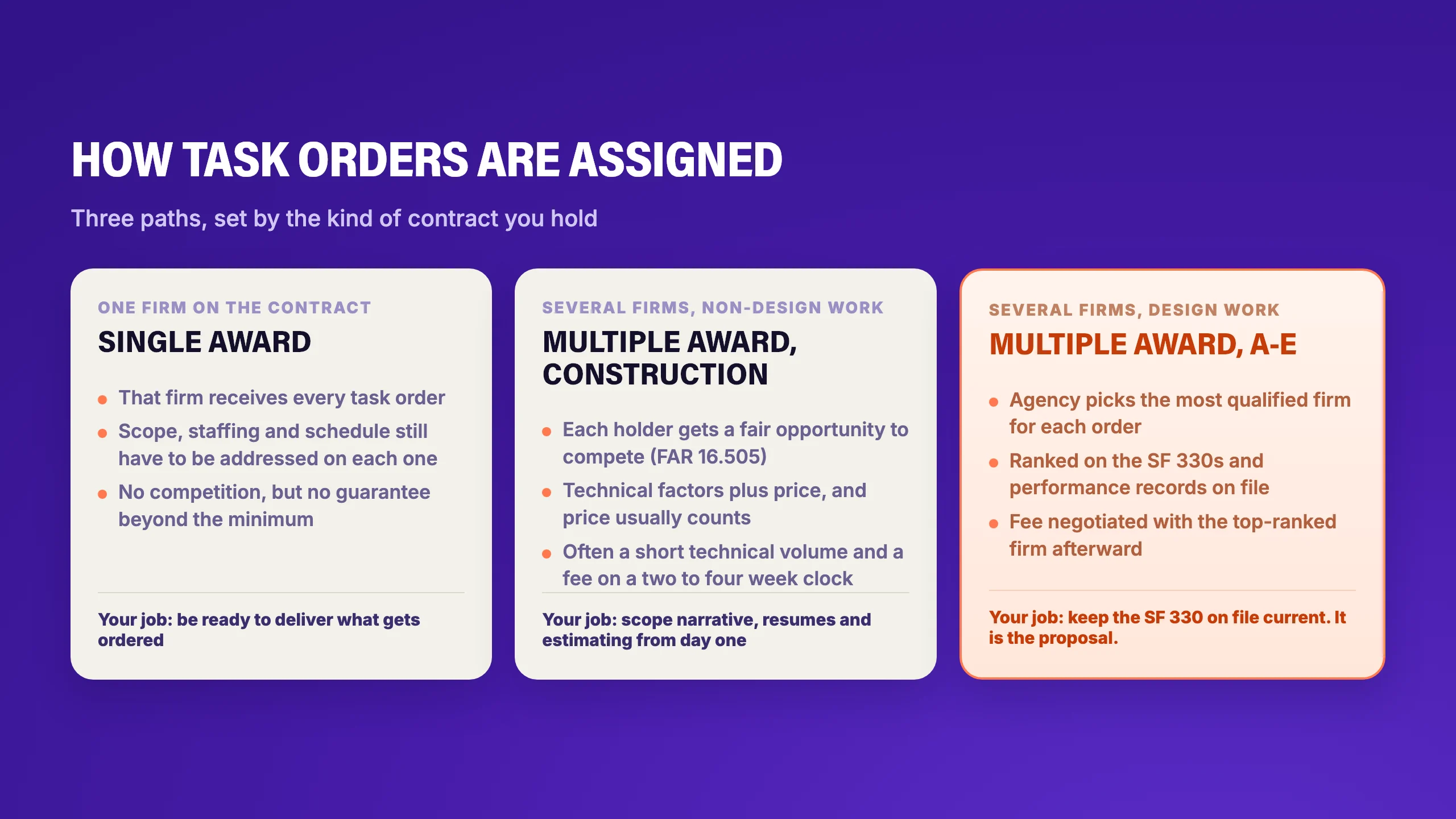
For multiple-award contracts, FAR 16.505 provides fair-opportunity procedures that gives each holder a fair chance at each task order, with some exceptions. That doesn't mean every task order needs a full proposal. On a multiple-award contract outside A-E selection, what the contracting officer owes you grows with the size of the order:
- Orders over $350K (the simplified acquisition threshold): the agency must tell you what it’s buying and how it will choose, and give you a chance to submit.
- Orders over $7.5M: you also get the evaluation factors up front, a written explanation of the award decision, and a debriefing if you lose.
The contract and the order request determine what your team must provide.
A-E services require particular care here. Their selection rules affect both the initial award and the orders that follow.
How do A-E IDIQs differ from construction IDIQs?
Federal architect-engineer services subject to the Brooks Act follow qualifications-based selection. The agency ranks firms on qualifications first, then negotiates a fee with the top-ranked firm. If they cannot agree on fee, the agency moves to the next ranked firm. Construction procurement follows different procedures and typically evaluates price alongside technical factors, as the solicitation specifies.
For A-E services, FAR 36.602-1 names criteria that typically include professional qualifications, specialized experience, capacity, past performance, and location, but agencies may add or adjust criteria in the solicitation. FAR 36.606 describes the negotiation that follows selection.
The distinction carries through to task orders. Federal rules require orders under A-E IDIQs to follow the same qualifications-based selection process, and federal law bars DoD, NASA and the Coast Guard from routinely asking holders for more qualifications information on each order.
That is why a generic explanation of task-order competition can send an A-E team in the wrong direction.
That also changes proposal planning. On an A-E pursuit, marketing needs convincing evidence of the proposed team's relevant work. Under USACE's simplified task-order selection procedures, the agency ranks firms in the awardee pool on the SF 330s and performance records already on file and takes no supplemental submissions unless the existing qualifications are insufficient, so the SF 330 you keep current can be the main basis for task-order selection.
On a construction task-order response, the pursuit team may also need close coordination with estimating around a specific scope and price.
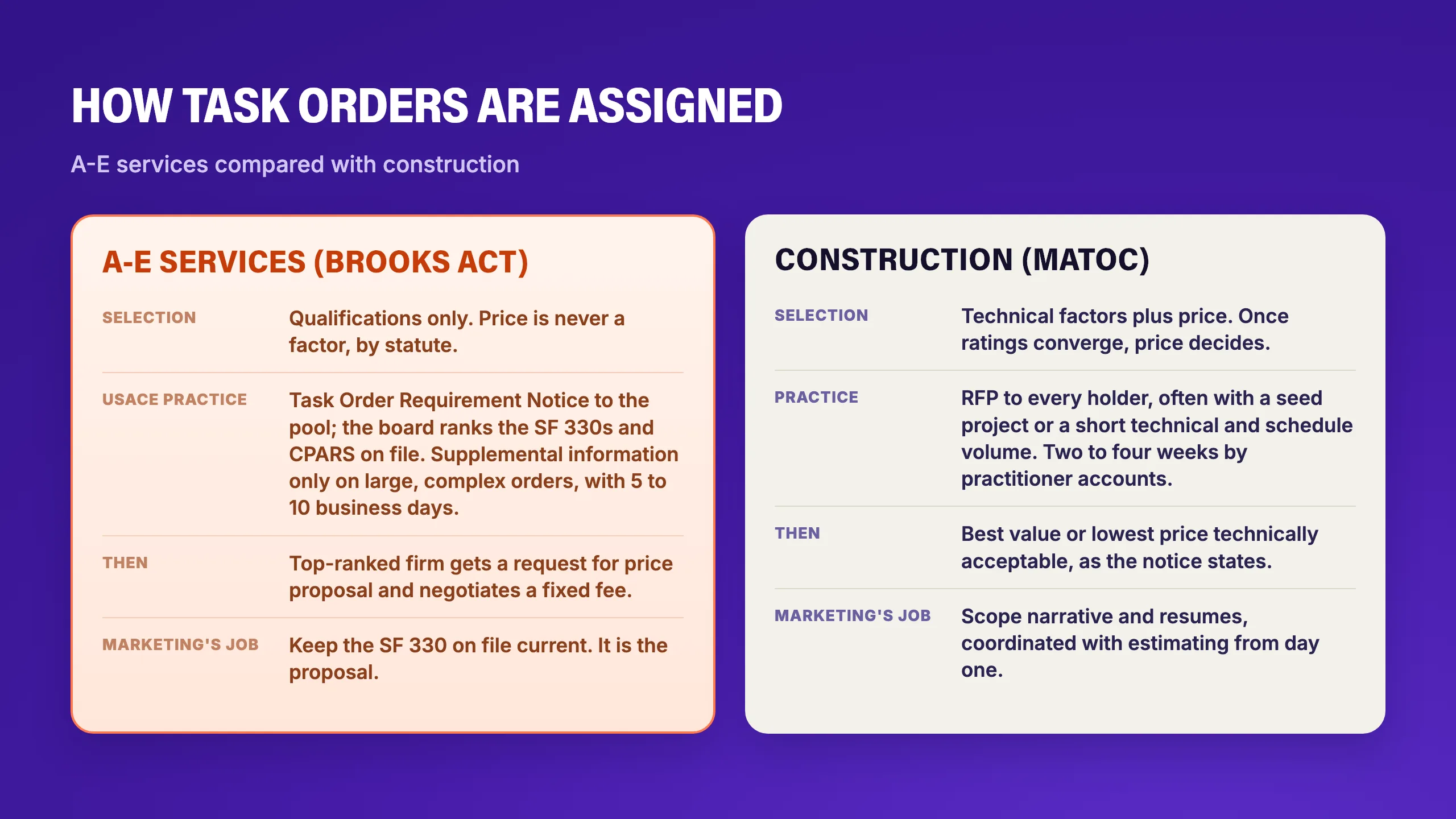
Always check the solicitation, the agency's instructions and any deviations. The IDIQ label alone won't tell you how the selection worksAgencies are also adopting a rewritten FAR, so the rules your solicitation cites may differ from those described here. The solicitation governs.
How do you decide whether an IDIQ is worth pursuing?
A useful go/no-go assessment starts with the likely assignments and your firm's competitive position, then adds the effort required after award. Winning a place on a contract can be valuable, but that value depends on whether the agency is likely to order work your team can win and deliver profitably.
Looking at the anticipated work is a good place to start. Review the agency's published plans, previous awards, and available task-order history on SAM.gov or HigherGov. Which disciplines recur? Which locations and assignment sizes keep coming up? Historical activity doesn't guarantee future demand, but it does provide a useful basis to ask the right questions.
Then, bring operations into the conversation. If the expected work needs a specialist who's already committed elsewhere, that affects the pursuit now. The same goes for geographic coverage, subcontractor availability, and managing several assignments at once.
Make sure you budget for the pursuit effort after the award. When some USACE districts began asking for mini-proposals on task orders, ACEC's procurement advocacy chair put the cost on the record in 2020: an additional eight to 16 hours per task order, at an average win rate of about 25%. That practice predates the current restriction on routine requests for additional qualifications, so treat the figures as a cautionary benchmark rather than today's norm.
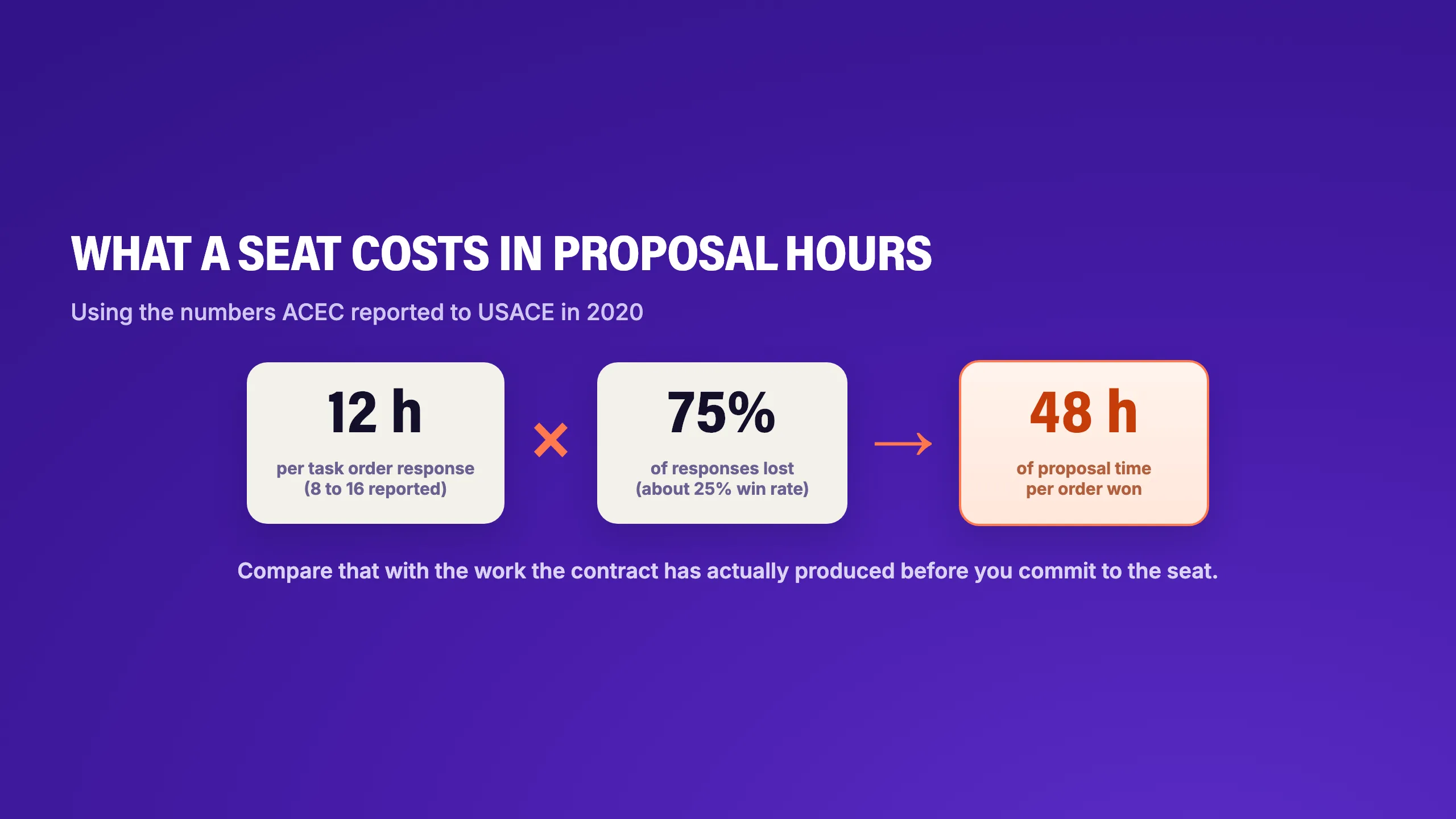
The lesson: a team can spend heavily to win the base contract, then discover it has neither the proposal capacity nor the technical availability to respond well to the work that follows. The base award is only the starting line. The recurring workload is the task-order response, so plan a repeatable process that saves effort for the scope, staffing, fee, and risks that change with each order.
And be explicit about assumptions. Dividing a shared ceiling by the number of awardees doesn't tell you what your firm should expect to earn. A stronger forecast starts with identifiable assignments, your ability to win them, and the resources you need to deliver them.
Take the Air Force example. On paper, $1.5 billion split across 27 firms is about $55 million each. Now run it with assumptions you can defend (illustrative numbers):
$2.5 million a year can still justify a pursuit, but you’d plan staffing and pursuit budget very differently than you would for $55 million. Replace each assumption with the agency’s actual ordering history and your own task-order win rate
What should a strong IDIQ response demonstrate?
Your initial IDIQ response needs to establish that your team can perform the anticipated work across the contract's scope. That calls for deliberate project selection, clear personnel roles, and a credible account of capacity. The agency should be able to connect each major requirement to evidence in your response.
For federal A-E pursuits, the SF 330 is central to presenting qualifications. Part I is the pursuit-specific package: Section E resumes for the proposed team, Section F example projects, and the Section G matrix that shows which people worked on which projects. Part II is the firm's general qualifications, and agencies keep it on file.
Building that qualifications package starts with matching the required roles to relevant experience. A marketer at one engineering firm described her process to us:
"Step one is usually to see if the solicitation tells us what roles we have to fill."
From there she builds a spreadsheet mapping the required roles to selected projects and the people connected to that experience. That spreadsheet is the evidence map, built by hand.
Federal rules tell agencies to review those files at least once a year and to encourage firms to submit an updated SF 330 annually. USACE’s own A-E contracting pamphlet says that around the anniversary of the base contract award, Contracting will request an updated SF 330 Part I and Part II from each firm.
On a USACE IDIQ, that file can be the main basis for the next year's orders, so treat the update as a pursuit deadline. Follow the specific announcement for required parts, page limits, and supplemental information, and run the submission against a compliance matrix the same way you would a full proposal.
Consider an engineering firm pursuing an IDIQ for water infrastructure services. Its largest treatment plant project might be a strong example of design capability. But a response built entirely around that project could leave unanswered questions about rehabilitation, field investigations, or work in operating facilities.
The project selection discussion should expose those gaps before writing begins:
Project relevance and personnel relevance also need to agree. If you feature a project because of its difficult phasing, make clear who developed that approach and whether that person is on the proposed team. In one protest, NASA lowered a firm's capacity score on a single-award A-E IDIQ that proposed part-time rather than full-time key personnel, which raised concerns about meeting schedule demands. GAO found the concern reasonable and denied the protest. The lesson: don't leave the board to infer the connection.
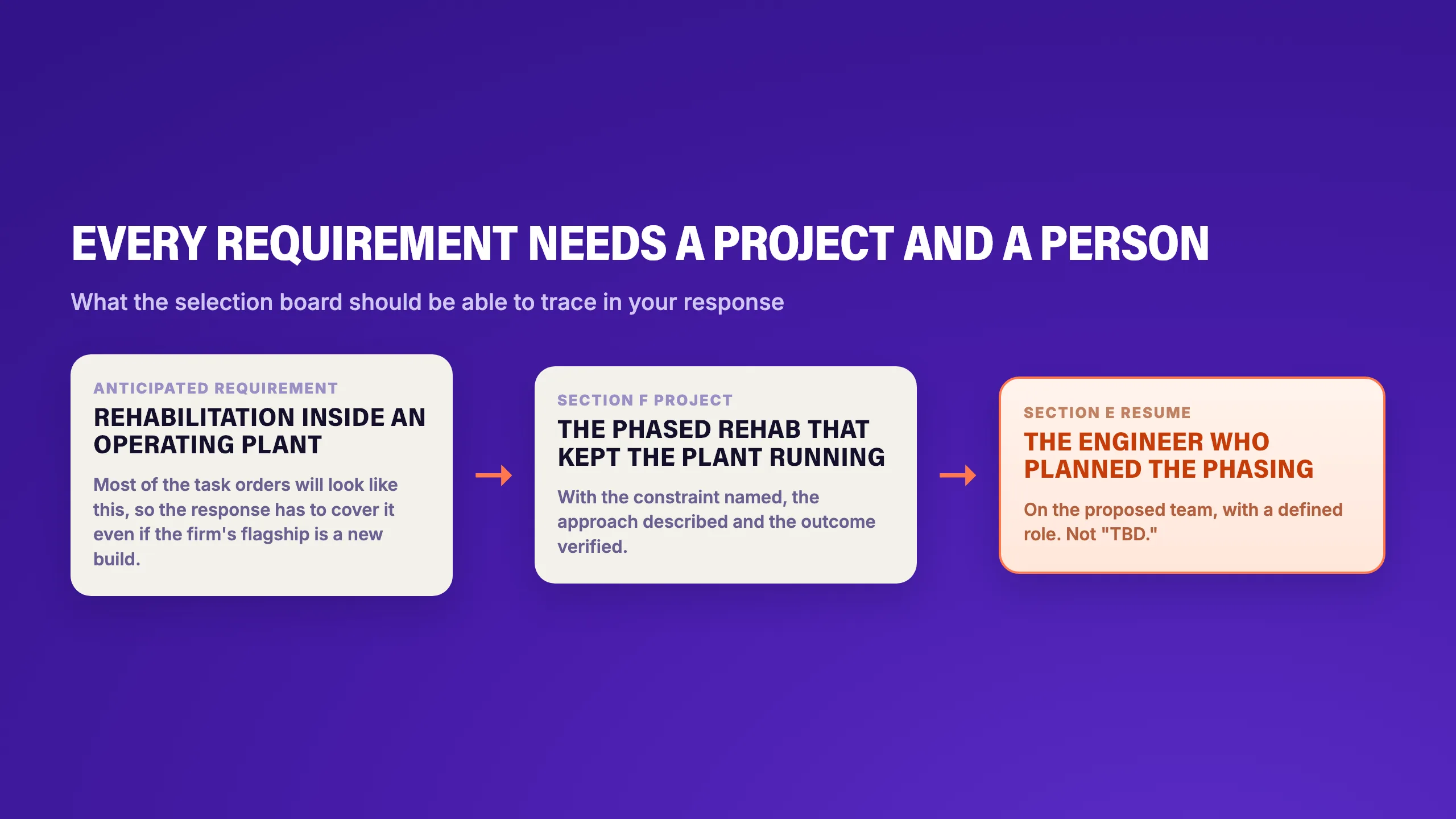
This is where proposal managers can improve the substance of the response. A request for a recent resume is easy to fulfill and may still miss the question. Asking which proposed engineer handled the comparable operating constraint gets you closer to evidence the agency can evaluate.
💡Pro tip: Kantiv lets proposal teams review people profiles and past projects, then link selected records to the pursuit workspace. Reviewers can examine resumes, notes and supporting files to substantiate each person's contribution. The team still has to verify actual roles and availability before making commitments.
How should your team prepare for task orders after award?
After award, your pursuit team needs a reliable way to keep contract requirements, qualifications and new project experience current. Each task order introduces a particular need. Your response process should help the team find the evidence that fits that need and confirm the people who can actually do the work.
Make the award handoff useful
Schedule the handoff soon after award, while the pursuit details are still fresh.
Before the pursuit team scatters back to their day jobs, give marketing, business development and operations one shared account of what the firm just signed: the scope, the ordering procedures, the points of contact, the key personnel you promised, and any restrictions that will shape future responses.
Agree who monitors incoming requests, who coordinates the response and who confirms staffing. Include the contracting lead when interpreting obligations. An internal decision to pass on an assignment has to take account of what the contract requires.
Tailor the evidence to the assignment
Let’s return to our earlier example: the water infrastructure firm. Suppose an upcoming assignment concerns rehabilitation at a treatment plant that must stay operational. The initial qualifications package did its job by establishing the firm's range of capabilities. Now, the question is narrower: has this firm rebuilt a plant with the water still running, and who on the team did it?
The table should drive the next work session. The technical lead identifies the projects that match the assignment, then explains why those details matter for the plant, schedule, shutdown limits, and operating constraints. Marketing turns that evidence into the format the agency requested, whether that is a short update, a project sheet, or a task-order response. If the agency asks only for a limited qualifications update, stay within that scope and do not rebuild the full IDIQ proposal.
💡Pro tip: In Kantiv, teams can link relevant past projects, people and reference files to a pursuit workspace, then use Smart Draft to develop a first draft from those materials. For the water rehabilitation example, that means selecting evidence about phasing work in operating facilities rather than carrying forward a broad water-sector narrative. Technical leads still confirm the approach.
Capture the experience while it is still accessible
When an assignment hits a real milestone or closes out, write down what the team actually did, while the people who did it still remember. Record who held which role, what constraints they worked around, what the outcome was, and where the proof lives. Keep what the proposal promised in a separate column from what the project delivered.
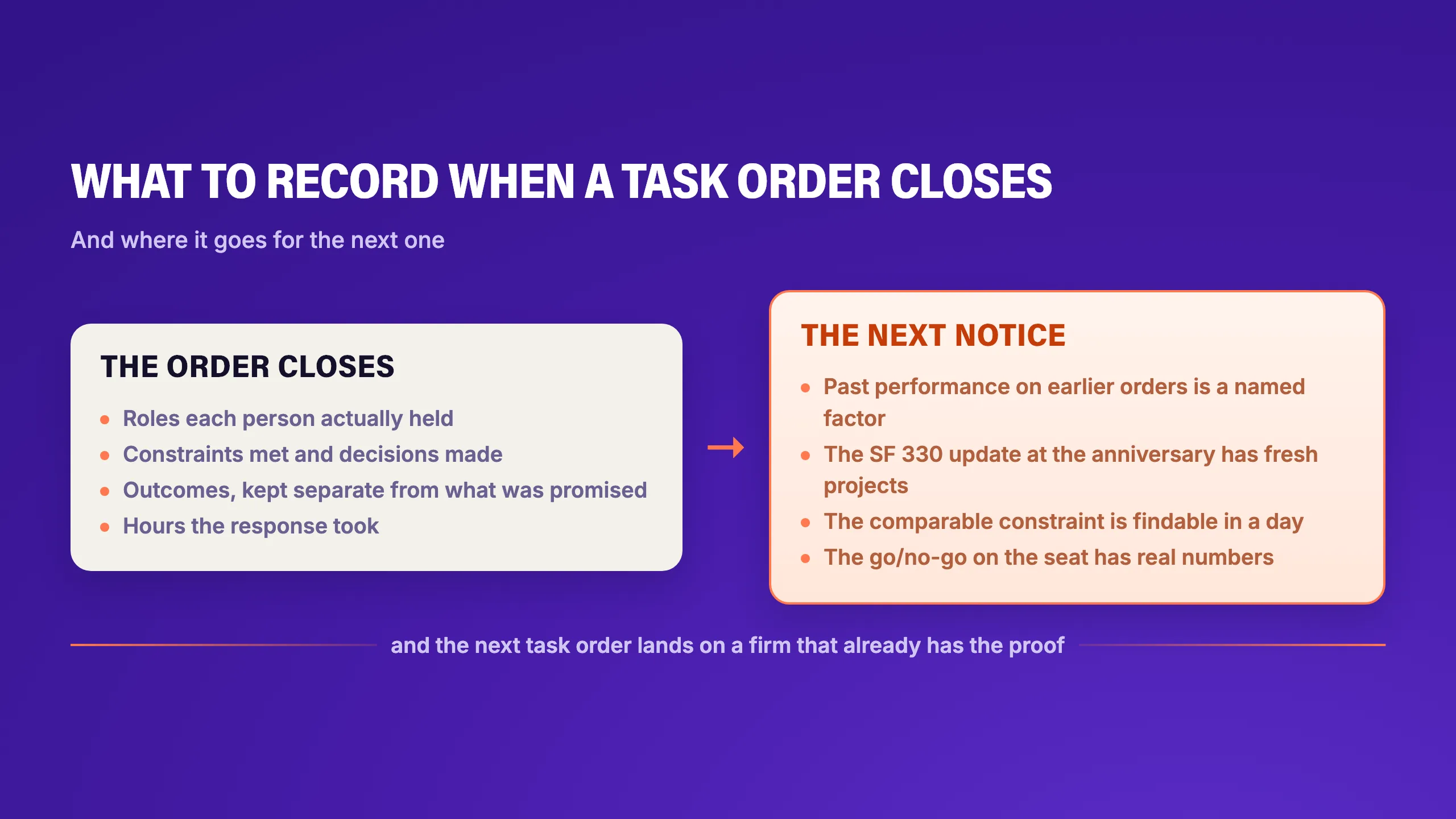
The cost of losing that information compounds over the life of an IDIQ, because the same contract keeps asking for related experience, and the fair-opportunity rule tells contracting officers they should consider past performance on earlier orders under the contract. So don't ask project teams for "an update." Ask them to verify a specific draft or fill a known gap while the work is fresh, then put the answer somewhere the next pursuit team will actually find it.
Material built for one request is easy to lose if nobody captures it while the work is fresh. One marketing lead described the challenge to us:
"Everything just goes away and they don't know where to source it from because they can't find it anymore."
This matters when the assignment becomes an example in a later pursuit. A description written before work began may carry a schedule or an approach that changed, and reusing it unchecked turns an old plan into an unsupported claim about performance.
💡Pro tip: Kantiv's Data Collection Agent can interview project leads about delivered scope, constraints, individual contributions and outcomes. With human review configured, a reviewer checks the resulting write-up before it is saved to the project record.
Measure the work that follows the award
Finally, make sure your team tracks base-contract wins separately from task-order activity. Useful measures include assignments received, responses prepared, selections won, pursuit hours and contribution from delivered work. For A-E contracts, use measures that fit the actual selection process rather than forcing every order into a competitive-bid win rate.
A contract with few orders deserves a closer look. Has the agency ordered less work than expected? Is the work going elsewhere? Is your firm unavailable for the assignments being offered? Each answer calls for a different decision.
How Kantiv supports IDIQ contract pursuits
IDIQ pursuits reward continuity. Your firm needs to retain the evidence behind the original award, make it usable for later assignments, and add new experience as the work progresses. That becomes difficult when the details live in old proposals, and across scattered systems.
Kantiv is a pursuit intelligence platform that maps a firm's people, past projects and historical performance into a structured Knowledge Graph. It helps firms pursue IDIQs by turning past experience into relevant, evidence-backed responses, for both the initial contract and the task orders that follow.
Kantiv helps proposal teams:
- Find relevant qualifications: retrieve projects, resumes and past proposal content that demonstrate the requested experience.
- Build tailored responses: bring selected evidence into a pursuit workspace and develop first drafts rather than starting from scratch.
- Review before submission: check drafts against requirements and supporting sources, with people verifying accuracy, staffing and technical approach.
- Strengthen future pursuits: capture delivered experience through the Data Collection Agent, then review it before reuse.
Book a demo and see how Kantiv can help your team prepare for its next IDIQ pursuit.
FAQs
Is an IDIQ the same as a task order?
An IDIQ sets the contractual framework for future work. A task order defines an individual assignment under that framework. Your proposal team should keep both sets of requirements available when preparing a response.
Can an IDIQ use fixed-price task orders?
Yes. IDIQ describes the ordering arrangement, and fixed-price describes how work is priced. Under FAR 16.501-2, an IDIQ can provide for fixed-price task orders. Check the contract for the permitted pricing structure and instructions.
Are on-call contracts and IDIQ contracts interchangeable terms?
They can describe similar working arrangements, but the terms alone don't establish identical procurement rules. State and local on-call contracts follow the applicable jurisdiction's requirements, and FHWA-funded DOT on-calls for engineering and design-related services follow 23 CFR 172. Confirm the actual contract structure before applying federal IDIQ guidance.
Does every task order require a new SF 330?
No. The SF 330 is usually the main qualifications package you submit to get on the contract. Task order requests often ask for something lighter, such as a short technical proposal and a fee.
Can we protest a lost task order?
A protest at GAO is available when the order exceeds $10 million at a civilian agency or $35 million at DoD, NASA or the Coast Guard (the FAR text still, as of October 2026, prints the older $25 million figure), or when the protest argues that the order increases the contract's scope, period or maximum value. Below those thresholds, fair-opportunity complaints go to the agency's task-order ombudsman, which reviews them but is not a protest forum.
How does Kantiv help?
Kantiv supports pursuit preparation. It does not administer federal contracts, certify legal compliance or guarantee task-order awards. The team still confirms availability, develops the approach, and approves the response. Kantiv helps it start with the experience the firm already has.