Found the content on this page useful? Share it with your team!
Client Intelligence for Go/No-Go Decisions: Stop Approaching Every Pursuit Like a Blind Date


Table of Contents
You have worked with this client for seven years. You have their old RFPs. Your proposals. Evaluator scores. Project history. Maybe a debrief or two if somebody remembered to save them. Then a new opportunity appears and the kickoff starts with: “So, what do we know about them?”
That is an odd way to treat a repeat client. It is a bit like going on a fifth date and asking, “So, what do you do for fun?”
The information exists. You have already paid to learn it—in proposal hours, project delivery, losses, debriefs, and occasionally expensive mistakes. What most firms do not have is somebody with two free days to read all of it before the next pursuit starts.
That is what client intelligence should solve: analyzing a firm's past RFPs, proposals, evaluator scores, and debriefs on a client to inform the next go/no-go decision. It is exactly the kind of work I want an agent doing.
Not deciding whether we bid. Not inventing the win strategy. But reading the history, connecting the evidence, and putting the useful parts in front of the people who need to make those calls.
What seven years of client history revealed: a client intelligence case study
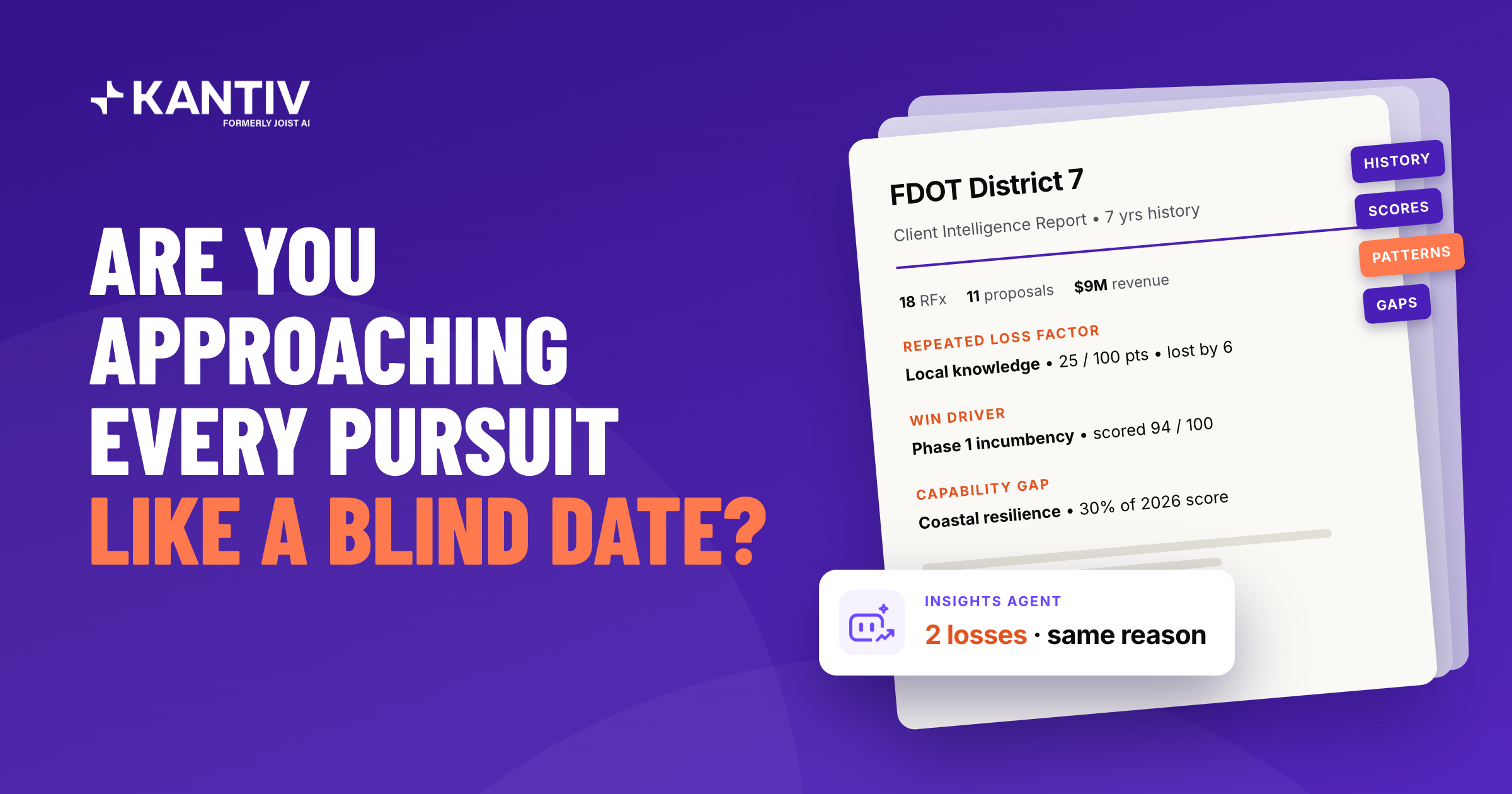
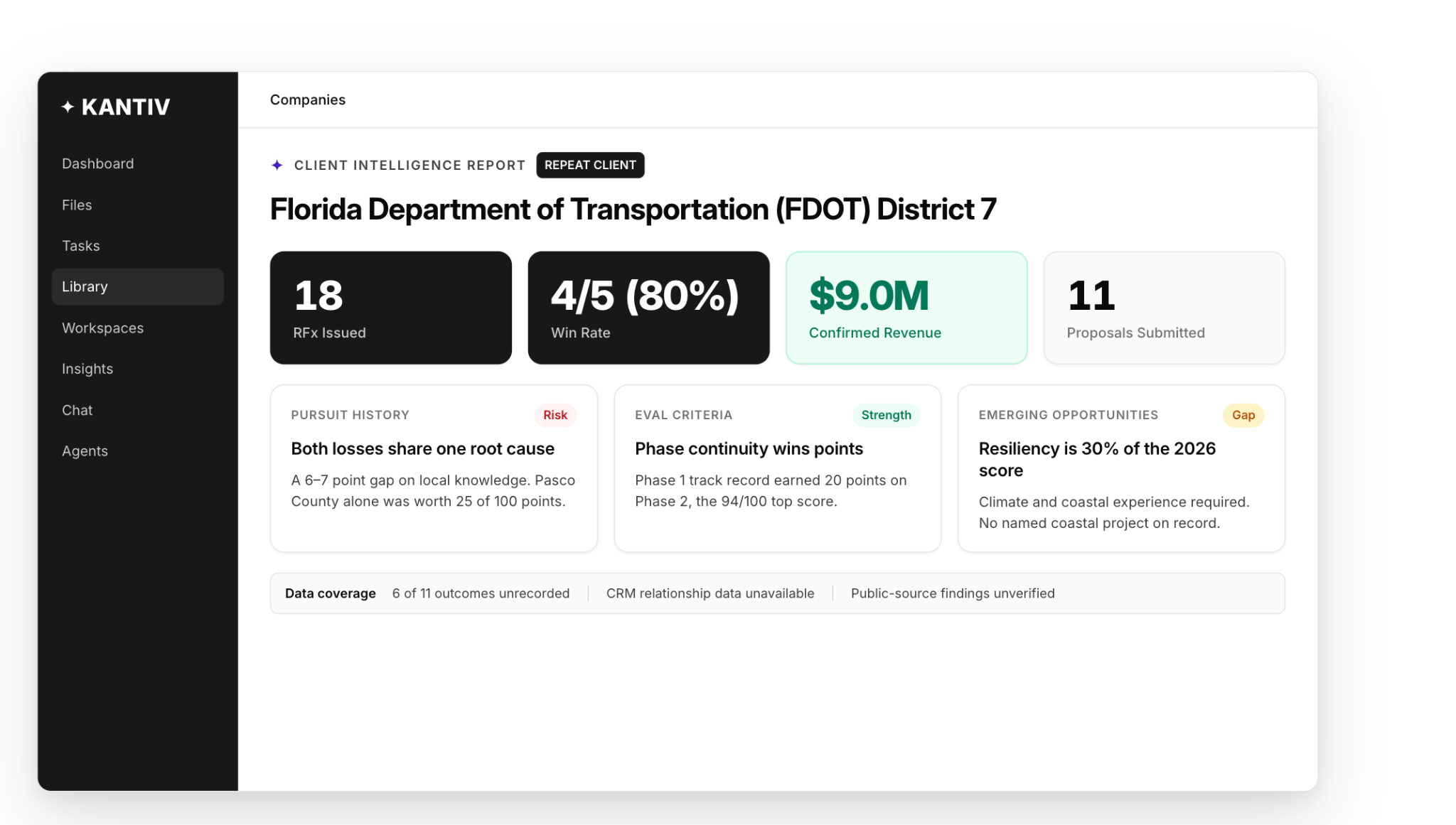
We ran Kantiv’s Client Intelligence Agent across a fictional engineering firm’s history with Florida Department of Transportation District 7. There was plenty to nibble on: 18 RFx, 11 submitted proposals, seven years of pursuit history, and $9 million in confirmed revenue.
Most firms would probably summarize that relationship as: Good client. Strong track record. Keep pursuing. Reasonable. Also incomplete. And, if you’re honest, not super useful. Instead, the Agent ran a win/loss analysis across the full history as one record instead of 11 separate proposal files, and pointed to three things:
#1 The firm kept losing for the same reason
Two documented losses looked like two unconnected pursuits. They were not. In both, the client placed heavy scoring weight on local and geographic knowledge. In one pursuit, Pasco County knowledge alone accounted for 25 of 100 points, with the county’s public works director on the evaluation panel.
The firm lost by six points. Read that proposal by itself and you have a close loss. Read the history and you have a pattern.
That changes the conversation before the next pursuit. Do we now have credible local experience? Do we need a partner? Do we need to build that credential first? Or are we about to spend another few hundred hours discovering, for the third time, that the client meant what it put in the scoring rubric?
That is what makes the Client Intelligence Agent valuable. It is not just saying, “Here is some information about this client.” It is saying, “You have seen this pattern before. Deal with it before you decide to bid.” And you can be the one bringing that information to the table as marketing.
#2 One win showed an advantage worth engineering again
The strongest documented proposal in the record scored 94 out of 100. Twenty points were tied to past performance on Phase 1 of the same work. As the incumbent, the firm had evidence its competitors simply could not reproduce.
That is more useful than knowing “we tend to do well with this client.” It tells you why.
If the client repeatedly structures programs in phases, then winning Phase 1 and documenting the delivery well moves beyond project execution to work that feeds into your position for the next pursuit.
That lesson is easy to miss when every proposal gets filed away in a silo as an individual event.
#3 The next big opportunity exposed a weakness before the team committed
The report also found the client moving into climate and coastal resilience. The 2026 resiliency RFP put 30 percent of the available score on climate and coastal engineering experience.
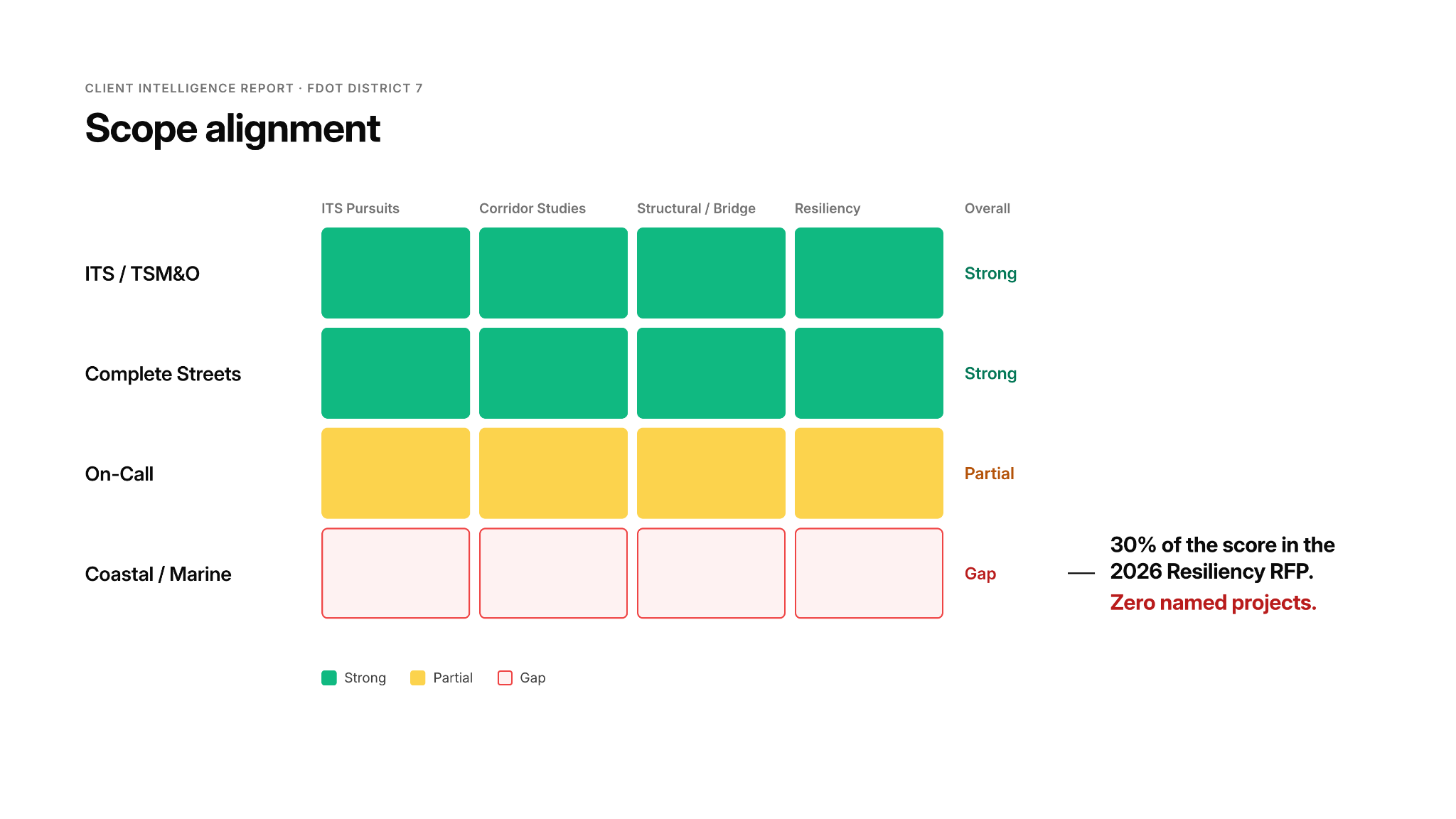
The firm had no named coastal project in its proposal record. That is the kind of finding I would rather see before the kickoff than halfway through Pink Team.
Now there are choices. Bring in a specialist. Build the credential through adjacent work. Pursue as a subconsultant first. Or decide this is not the opportunity where the team should spend its week.
That is a much better use of a go/no-go meeting than reconstructing seven years of client history from memory. And it also really helps marketing protect their bandwidth.
Why go/no-go decisions miss evidence most firms already have
The usual problem is not ignorance. Someone remembers the tough debrief. Someone else remembers the proposal where the client loved the team. A principal remembers a conversation from three years ago. Marketing knows which projects keep appearing in the submissions.
The evidence is distributed across people and systems. And the pursuit clock does not particularly care.
A go/no-go may look like a question about the opportunity in front of you: Can we win? Is the fee worth it? Can we beat the incumbent? But some of the most useful evidence is sitting behind you—in past proposals, RFPs, scores, debriefs, and project history.
Pulling all of that together manually means someone reading years of material against a live pursuit deadline. Most teams do not have that afternoon.
That job just gets harder as the pursuit volume rises. The workload is not getting lighter either.
Deltek’s 2026 Clarity research report found A&E firms submitted 32 percent more proposals while win rates declined. SMPS data puts 69 percent of AEC marketing departments at fewer than 10 people.
More pursuits. Lean teams. More history to interpret. Less time to interpret it.
At some point, “we know this client pretty well” has to stop being a strategy.
How AI agents support AEC marketing before the proposal starts
A lot of the current AI use cases in AEC marketing still start once the pursuit is underway: Write this paragraph. Summarize this RFP. Rewrite this project description.
Useful? Certainly! But I think some of the more valuable agent work happens before anybody starts writing.
For a repeat-client pursuit, Kantiv’s Client Intelligence Agent can read the history and prepare the evidence before the strategy conversation begins:
- What has this client repeatedly prioritized?
- How have its evaluation criteria changed?
- Where has our firm consistently scored well?
- Where have the same weaknesses appeared?
- Which proof points have actually supported wins?
- Where does the next opportunity ask for experience we do not yet have?
- What information is missing or unreliable?
That means your first conversation can start with interpretation rather than archaeology.
Kantiv Insights Agents are designed to synthesize pursuit history into evidence the team can use, while the final judgment stays with the people who know the client, the opportunity, and the firm.
An agent can tell you that local experience has repeatedly cost you points. Your relationship lead may know the client has a new district manager.
An agent can show that a particular positioning approach correlated with the strongest scores. Your pursuit leader still decides whether that argument makes sense now.
The agent does the processing. The team does the thinking.
Sounds like a comfortable division of labor to me.
Client intelligence is only as good as the history underneath it
There is an inconvenient part to all of this. No agent can analyze the debrief nobody captured.
It cannot use the project lesson still sitting in a PM’s head. It cannot reliably compare win rates if half the outcomes were never recorded.
The FDOT report itself makes those limits visible. Six of the 11 proposal outcomes were unrecorded, CRM relationship data was unavailable during the analysis, and public-source findings were marked as unverified rather than silently treated as fact.
I actually like that. An agent that tells me where its evidence is weak is more useful than one that confidently fills in the blanks.
It also exposes the dependency most AI demos skip over: better intelligence requires better institutional knowledge underneath it. That is where Kantiv Data Agents come in.
Our Data Agents are aimed at the fairly unglamorous work that makes everything downstream better: tagging incoming records consistently, identifying stale or missing information, gathering project and personnel updates, and routing changes through human review.
If you want the deeper version of that problem, read our piece on how Kantiv Data Agents keep AEC firm knowledge usable. The short version is straightforward. A firm’s knowledge usually fails in three places:
- Someone never captures it.
- Someone captures it, but nobody can reliably find or classify it.
- Or it was accurate once and slowly became wrong.
The Data Agents piece makes the consequences pretty concrete: an agent cannot use the project story that was never recorded, and a folder full of PDFs does not automatically equal usable data.
Clean up that foundation and the more interesting capabilities improve with it—project matching, client intelligence, pursuit analysis, resume generation, and Chat.
There is a natural order to this: First, make the firm’s knowledge usable. → Then let agents do the reading humans rarely have time to do. → Then let humans spend their time deciding what the evidence means.
The report should be waiting when the pursuit opens
What I find most compelling about what we’ve built is that nobody has to remember to request “client research” three days after the RFP arrives.
The pursuit opens. The Workspace already has the relevant firm context. The Client Intelligence Agent has done the first pass across the relationship and pursuit history. The strategy meeting starts from evidence. And when the team wants to go deeper they can interrogate the underlying knowledge in Kantiv Chat rather than start another search across old folders.
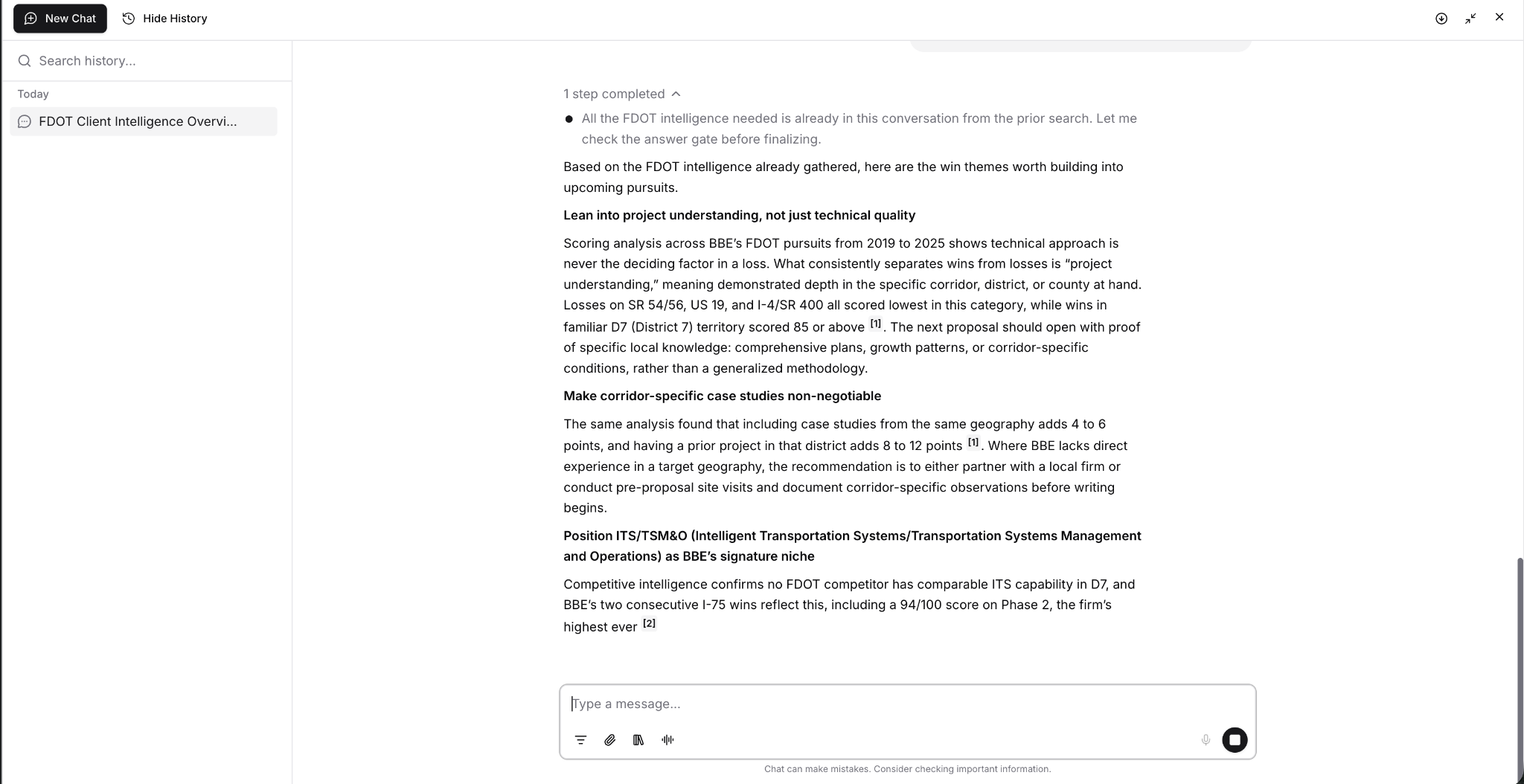
That is when all these pieces begin to connect. Data Agents help keep the institutional knowledge usable. Insights Agents read across it. Workspaces put it in the context of the live pursuit. Chat lets the team keep questioning it.
None of those things replaces the person who knows the client. They give that person a considerably better briefing.
Try it on the client everyone says they know
There is an easy test for this. Pick the repeat client where everyone says: “Oh, we know them really well.”
Run the Client Intelligence Agent before the next pursuit meeting. Then see whether it surfaces something the room was not about to say. That could mean:
- A scoring criterion whose importance has been increasing.
- A capability weakness behind two losses.
- A proof point that appears in every strong submission.
- A market the client is moving into before your firm has the credentials to follow.
- A pattern in your own positioning that nobody noticed because the proposals were written three years apart by three different teams.
If it finds nothing new, great. Your institutional memory is in unusually good shape. But, I would not bet the pursuit budget on that.
Your firm already knows a great deal about its repeat clients. The question is whether that knowledge reaches the people making the next decision while there is still time to use it.
Otherwise, seven years into the relationship, you are still showing up to every pursuit like it is a blind date. And at that point, the client is probably entitled to wonder whether you were paying attention.
If you are ready to stop reintroducing yourself to clients you have known for years, book a chat with our team. We’ll show you how Client Intelligence can put the history on the table before the pursuit starts.
FAQs
What is client intelligence in AEC?
Client intelligence is the analysis of a firm's past RFPs, proposals, evaluator scores, debriefs, and project history with a client to guide future pursuits and go/no-go decisions.
How does client intelligence improve go/no-go decisions?
It surfaces patterns, such as recurring scoring weaknesses or proven win themes, before the team commits proposal hours to a pursuit.
Can AI replace go/no-go decision making?
No. AI agents can read and synthesize pursuit history, but the bid decision stays with the people who know the client, the opportunity, and the firm.