Found the content on this page useful? Share it with your team!
5 OpenAsset Alternatives for AEC Firms in 2026 (Matched to the Job)

.png)
Table of Contents
If you're looking for an OpenAsset alternative, you likely already know (or have some notions about) how a digital asset manager (DAM) could aid your firm.
Maybe your firm already runs OpenAsset, and it’s doing the job it’s built for well. The project photos are tagged, the library is built, and anyone who needs an image can find one. Or maybe, your project photography currently lives across a shared drive and a couple of desktops, and you’re looking for a more efficient way to store and organize assets.
Or maybe, you've inherited a library nobody has maintained in a couple of years, and you've discovered that tracking down the right projects and resumes to actually put a proposal together is pretty challenging.
OpenAsset is a digital asset manager for AEC that recently added an AI proposal writer. There are a number of alternatives, but the right OpenAsset alternative depends on the situation you’re in, and the job you need done.
Kantiv, for instance, replaces the DAM's pursuit value with a knowledge layer built around your own projects and people.
Daminion and Bynder are other DAMs, at different price points and for different scales of firm.
Flowcase and ProjectMark solve adjacent problems (credentials and pipeline visibility), but are often among the tools that firms shortlist when seeking an alternative.
We wrote this comparison for AEC teams staring down an OpenAsset renewal or hitting its limits mid-pursuit. It covers each tool’s features, pricing, strengths, and limitations, so you can choose the tool that best fits how your firm works.
Before we get into the tools themselves, let’s talk about what OpenAsset actually does well, what it can’t do, and why firms typically switch.
What OpenAsset does well (and what it can’t do)
Let's give credit where it's due. OpenAsset organizes AEC digital assets and imagery well, with AI search, an employee module, and a text library. It also recently added Shred AI, a proposal layer with a Proposal Studio and AI chat over the firm's asset data.
Pricing is not published, but the company's own ROI calculator models roughly $3,600 to $4,800 in annual savings for a single office.
The problem? OpenAsset is a really good filing cabinet, but its ROI depends on labor. That labor often lands on the firm's most strategic marketing mind, the person who should be spending those hours pressure-testing which pursuits deserve a go, shaping the win strategy, and deciding which past performance makes the case for the client.
Doesn't Shred AI already solve this?
Wait, you’re probably asking yourself. Didn’t OpenAsset just add Shred AI, an AI proposal layer?
Shred gives OpenAsset's own images and resumes a Proposal Studio to draft from. This sits on top of the same asset library you already pay for and maintain. If OpenAsset is already the trusted source for your firm's images, resumes, and project sheets, Shred is worth testing as the proposal layer.
The open questions, though, are less about whether it can draft and more about what it's drafting from. At the end of the day, a proposal layer built on top of an asset library still reasons from assets. Can it work from live opportunity context, call notes, and win themes that never made it into a file? How does it handle project and resume records that have gone stale or conflict with each other? And is your library trustworthy enough for your team to make a true go/no-go call?
These are all questions worth pressure testing if you’re considering relying on Shred to win more pursuits.
The top OpenAsset alternatives, at a glance
| # | Tool | The job it does | Where it stops |
|---|---|---|---|
| 1 | Kantiv | Pursuit intelligence built on your own people, projects, and past performance, with image management & intelligence capabilities that replace the need for a DAM in the same system. | Overkill if you truly only need photo storage |
| 2 | Daminion | General digital asset management, with a self-hosted option | Mainly storage, worth testing on an AEC pursuit workflow |
| 3 | Bynder | Enterprise digital asset management for brand and marketing operations | Enterprise-priced; worth testing on a pursuit |
| 4 | Flowcase | CV and credential management built for AEC, with SF-330 support | Resumes and credentials; worth testing how far upstream it reaches |
| 5 | ProjectMark | A CRM for AEC pipeline and BD visibility | Pipeline visibility; worth testing what it adds once you are writing |
1. Kantiv
Kantiv, formerly Joist AI, replaces the question "where is the file" with "what wins this pursuit." It is a pursuit intelligence platform built specifically for AEC firms that win work on qualifications, and it works across the entire arc of a pursuit. Where OpenAsset stores your images, Kantiv ensures you not only find them, but also get value out of them.
A traditional DAM search runs on the tags a human typed in by hand, so it only finds what someone already described. Kantiv reads the pixels themselves, so it recognizes what's actually in a photo even where nobody tagged it, then tracks how many times an image has been used across your proposals.
Kantiv then surfaces every variant of the same asset, and runs coverage-gap analysis so you know which markets are thin on usable photos before a pursuit exposes the gap. None of the tagging work already done gets thrown out, either: existing IPTC/EXIF tags from Adobe Bridge and Lightroom carry over, so a firm switching isn't rebuilding its library from zero.
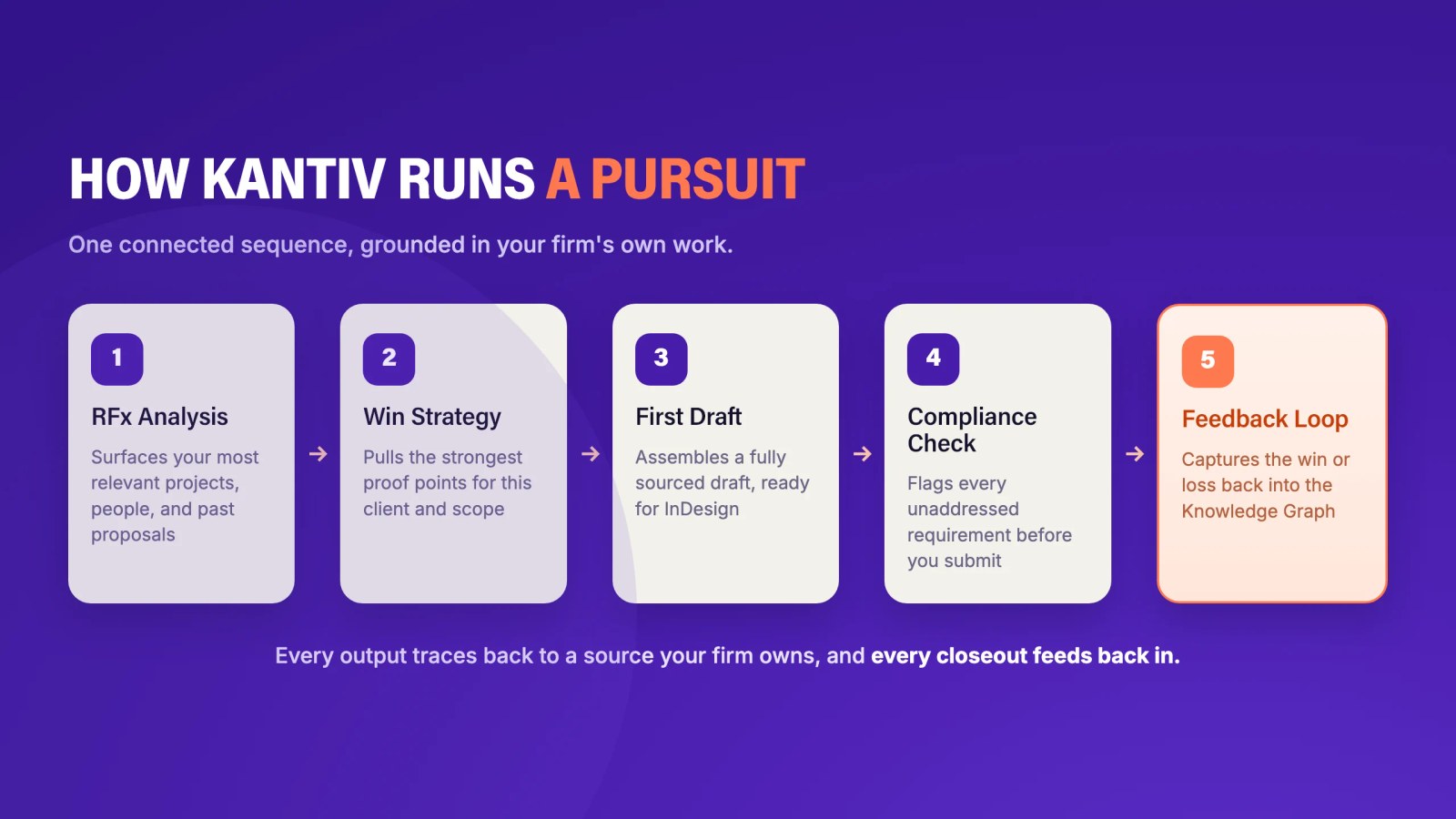
It starts before any RFx arrives. Content flows in from SharePoint, Egnyte, and Deltek. Kantiv maps your firm’s people, projects, clients, and past performance into a structured Knowledge Graph, pulls your strongest proof points for this client and scope, and assembles a fully-sourced first draft. From there, a compliance check flags every unaddressed requirement before the deadline, and Kantiv runs a feedback loop capturing the win or loss back into the graph.
SF-330 and SOQ work is native to the data model, and every output traces to a source your firm owns.
Key features
- Knowledge Graph linking your firm's people, projects, and history
- RFx analysis that matches the firm's most relevant proof to each pursuit
- Image search that reads image content directly rather than relying on tags, and carries over existing IPTC/EXIF tags from Bridge and Lightroom.
- Option for manually tag if teams prefer that level of governance.
- Tracks usage across documents, surfaces variants of the same asset, and flags coverage gaps by market
- Fully sourced first drafts with a built-in compliance check
- The people-project matrix is maintained continuously across every proposal
Strengths
- Solves the pursuit problem that drives OpenAsset switching, and the file storage OpenAsset already solved, in the one system
- Existing tagging work carries over
- Traceable outputs; nothing generated from thin air
- Builds from existing proposals, resumes, and project sheets, so there is no separate content structure for a coordinator to maintain by hand
Limitations to test
- More than a firm needs if photo storage is genuinely the whole requirement
- OpenAsset remains the right buy for a firm that specifically needs a dedicated AEC DAM with nothing else attached
Best for: firms who want a solution that helps them compound their firm knowledge, put their assets to work and create winning proposals quickly and accurately, getting better with every submission se real problem is winning work from their institutional knowledge. Firms like Robins & Morton cut award entry time from 30 hours to six on exactly this difference.
2. Daminion
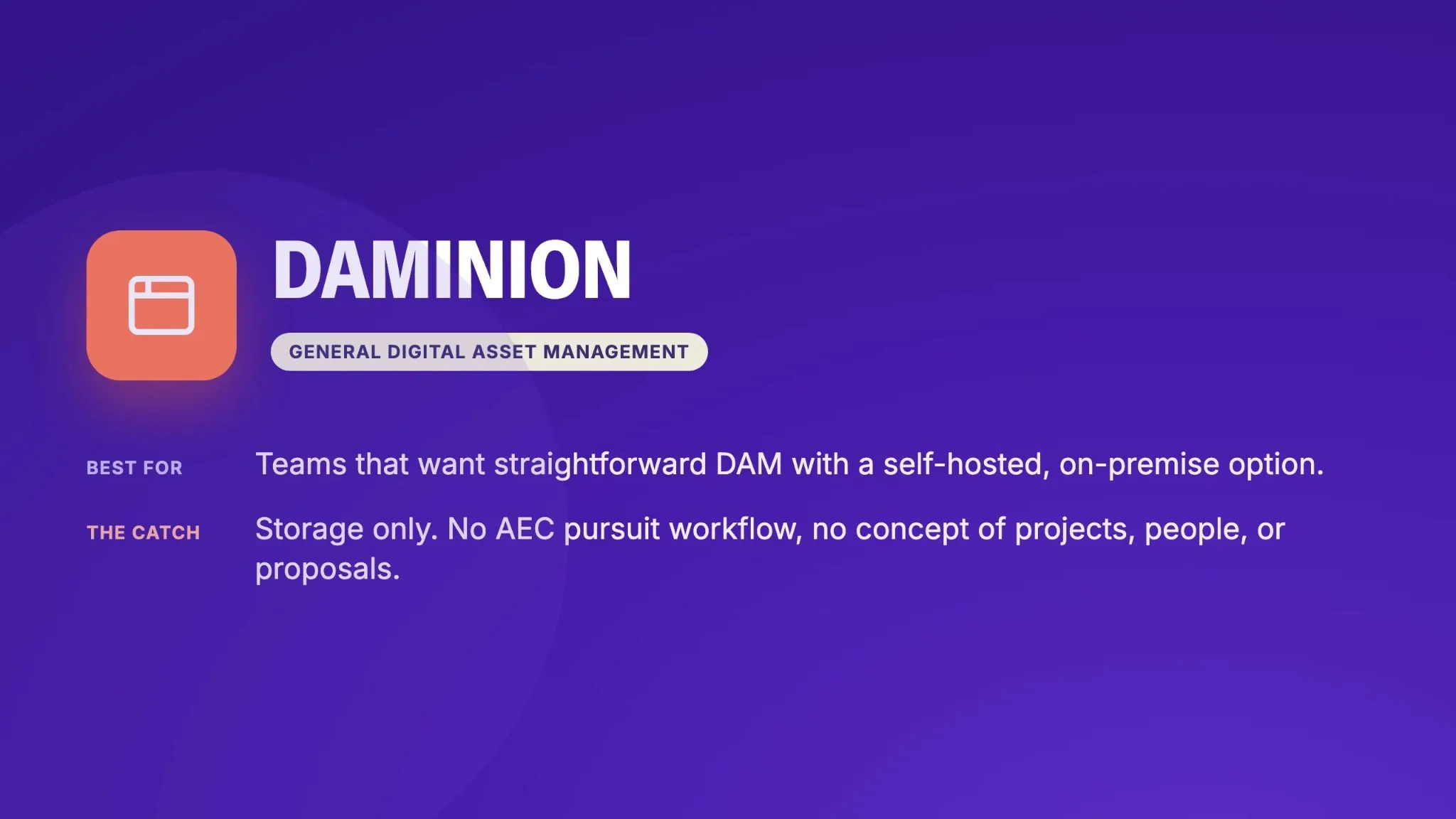
Daminion is a general DAM with a self-hosted option, which matters to firms with strict data policies, and a lighter commercial posture than the bigger incumbents. It solves the same imagery job OpenAsset does, at a different price point.
Key features
- Centralized storage with tag-based search, custom structures, and filtering
- Facial recognition, geo-tagging, and map views
- Duplicate elimination and 3D asset support
- Link-based sharing of large files and collections
- On-premise or cloud deployment
- Adobe Creative Cloud and Microsoft 365 integrations, plus an API and export SDK
Pricing: by quote, an annual subscription with all features included; AI tagging priced from $3 per 1,000 images; a lifetime license exists for nonprofits.
Strengths
- Self-hosting for firms that need assets on their own infrastructure
- Licensing includes all features, avoiding tier games
- Credible, cheaper storage swap
Limitations to test
- A general tool; AEC gets a menu mention, not a data model
- Limited to storage
Our take: a solid budget answer when storage truly is the whole problem. Daminion isn't positioned as a win-more-work tool, and it doesn't claim to be, which is exactly why the cost-driven switch works.
Best for: firms whose whole OpenAsset complaint is cost or admin weight, and who just want capable storage.
3. Bynder
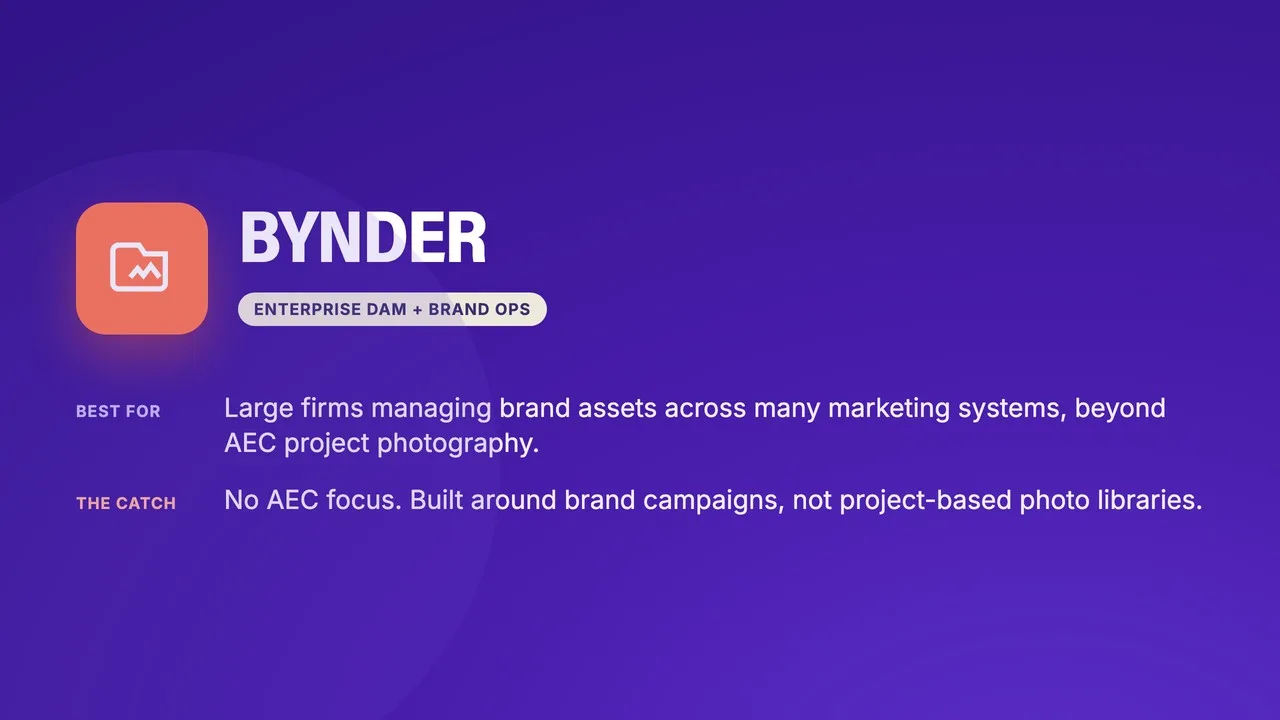
Bynder is a general enterprise digital asset management platform, used broadly across marketing and brand teams. OpenAsset's own comparison against it makes the point directly: Bynder organizes around brand assets and campaigns, not the project-based structure an AEC firm's photo library actually needs.
Key features (per Bynder's own product materials)
- Centralized brand and marketing asset library with AI-assisted tagging and search
- Brand guideline and portal tools for managing external-facing assets
- Workflow and approval tools for creative production
- Integrations across a broad MarTech ecosystem
Pricing: fully custom and quote-based; no published tiers. Per Bynder's own pricing page, cost is scoped to seat count, storage, usage across the firm's MarTech stack, which products are included, and the level of support purchased.
Strengths
- Mature, widely adopted DAM outside AEC, with a broad integration ecosystem
- Strong brand-governance and creative-workflow tooling for marketing teams managing external assets
Limitations to test
- Not built around AEC projects; a firm has to build that structure itself
- Enterprise pricing and scope, more platform than a firm that only needs project photography organized will want
Our take: a credible DAM if a firm's asset problem is brand and marketing operations at enterprise scale. For an AEC firm whose problem is specifically project photography and proposal support, it's more platform than the job requires.
Best for: large firms with a marketing or brand operation beyond AEC project photography, already managing assets across a broader MarTech stack.
4. Flowcase
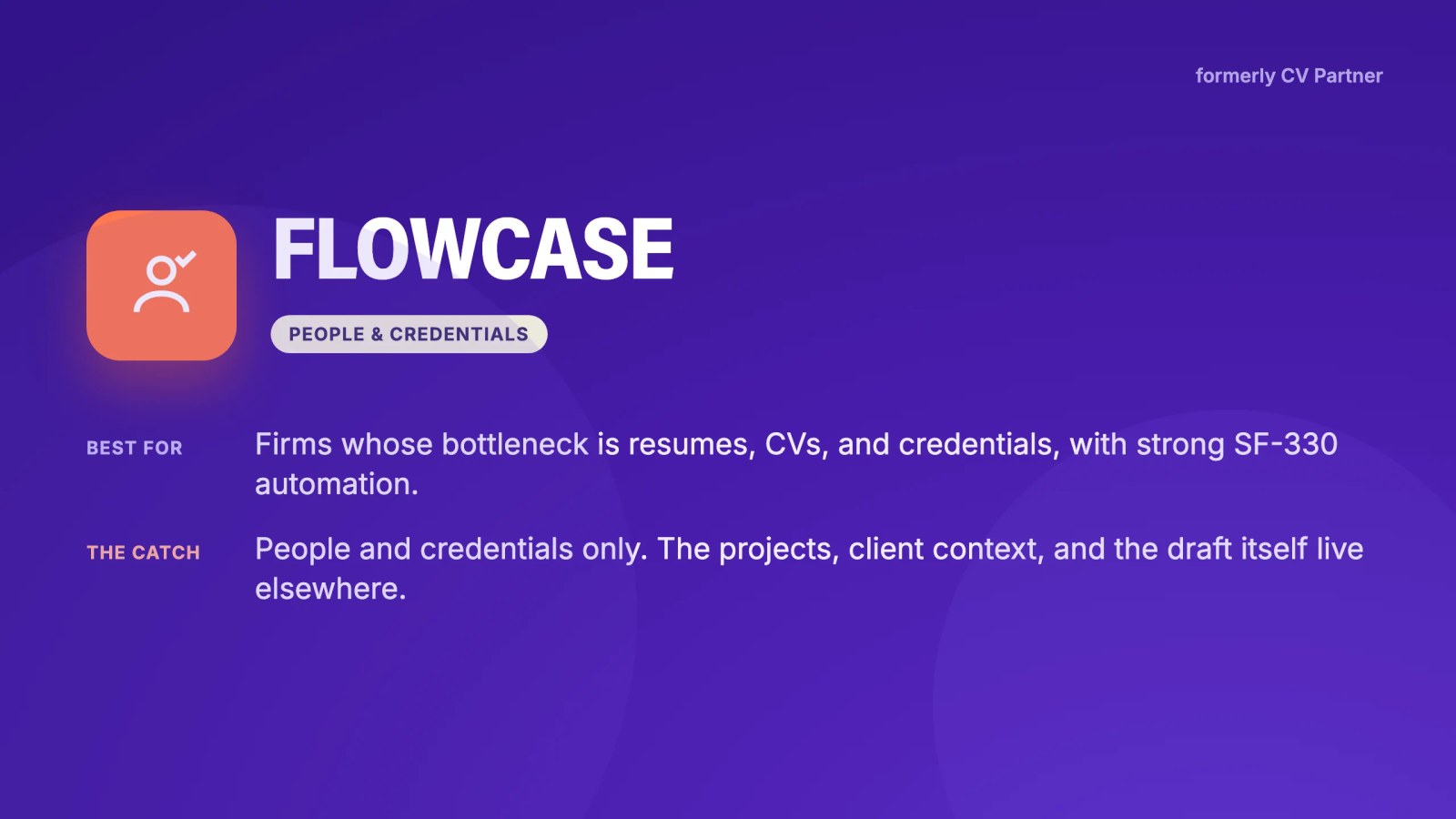
Flowcase (formerly CV Partner) manages resumes, CVs, and case studies for AEC firms, with SF-330 and other format automation built in. Firms shortlist it as an alternative when they find that the people content they’re getting from OpenAsset is stale. Flowcase targets that exact problem by holding people and projects as structured records rather than documents.
Key features
- Staff CV and resume database with role-based editing and automatic version control
- SF-330 Section II and Section E entries exported straight from the staff database
- Case study library with structured project data fields
- Configurable export templates for different pursuit formats
- Bulk update tools, so staff maintain their own profiles without a coordinator in the middle
- Integrations with Deltek Vantagepoint, Unanet, and major AHR systems
Pricing: tiered by user count, with starting prices published on the Flowcase website. Mid-market SaaS range.
Strengths
- Best in class for resume and credential management in AEC
- Native SF-330 support is rare, and genuinely useful for teams submitting government work often
- Staff self-service for CV updates takes real load off a coordinator
- The template system handles format variation across pursuit types cleanly
Limitations to test
- Purpose-built for credentials; pursuit-level relevance matching and RFP parsing are limited
- Worth testing how far upstream it reaches, into go/no-go, client context and win themes
- Per-seat economics at scale
- Across multiple offices, content governance takes a discipline the tool does not enforce on its own
Our take. If every submission means a coordinator chasing updated resumes and reformatting project sheets by hand, Flowcase solves that better than anything else here. It is a credentials tool, though, not a pursuit tool: it will not read the RFP or tell you which projects make the case.
Best for: firms whose bottleneck is credential management and SF-330 formatting, especially those submitting government work often.
5. ProjectMark
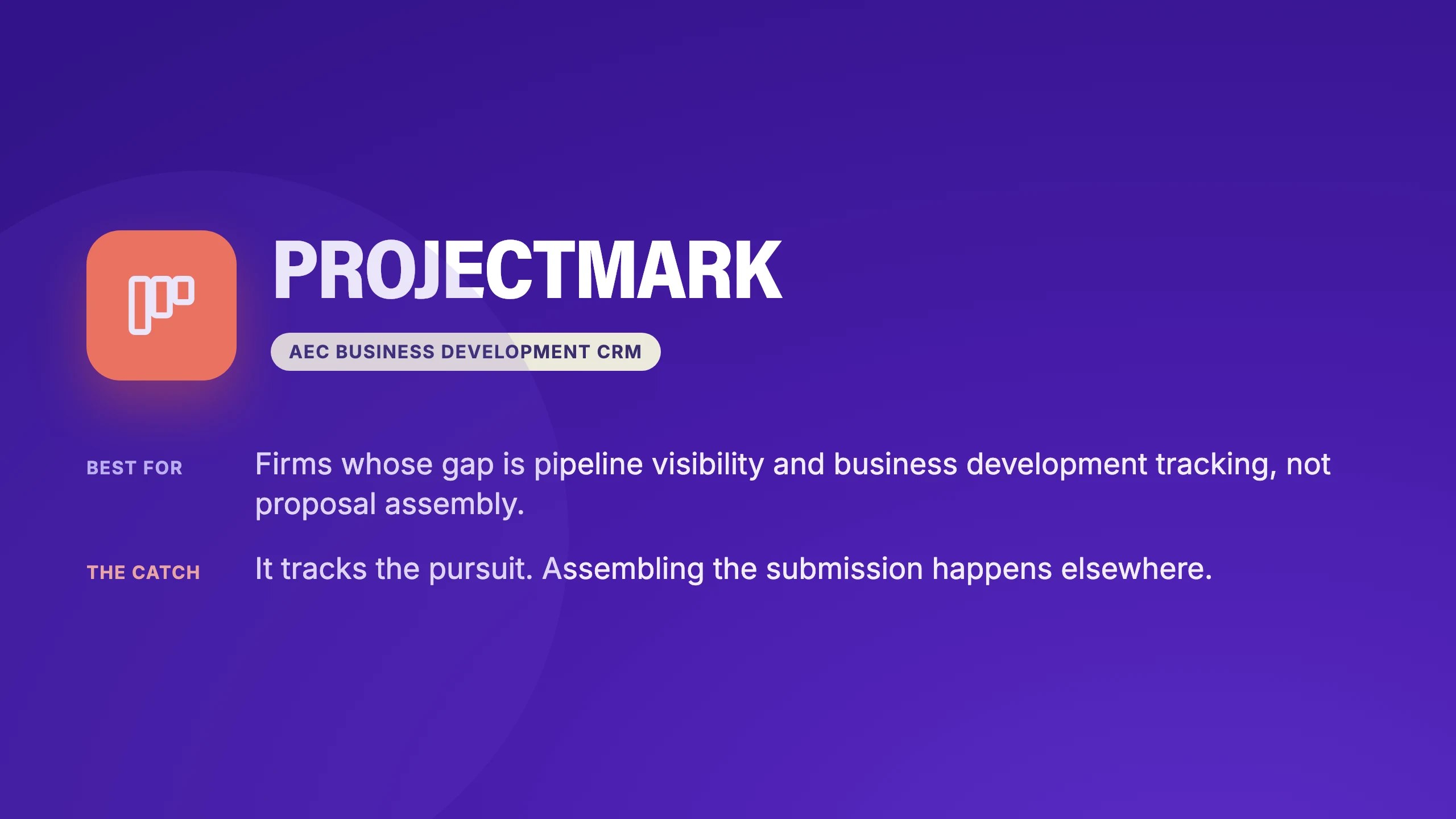
If your particular gap is that nobody can see what is in the pipeline, then ProjectMark is the tool for that. ProjectMark is a CRM purpose-built for AEC; firms shortlist it against OpenAsset when they need to move the projects they’re chasing out of a spreadsheet.
ProjectMark tracks which pursuits exist, and how they're moving through the pipeline. Assembling the qualifications that win them still happens elsewhere.
Key features
- Pipeline and deal tracking with revenue forecasting
- Contact and relationship management across clients and pursuit teams
- Analytics and custom reporting on pursuit activity
- Content management, task management and a shared team calendar
- Versions aimed separately at general contractors, specialty contractors, and architecture and engineering firms
Pricing: by quote, in tiers by team size.
Strengths
- Purpose-built for AEC business development rather than adapted from a generic sales CRM
- Answers the question a DAM cannot: which pursuits exist, and where each one stands
Limitations to test
- It tracks the pursuit; assembling the submission happens elsewhere
- Worth testing what it reaches once you are writing, given the export and resume-access complaints in public reviews
Our take. This is the tool for a firm that cannot see its own pipeline. It is a different purchase from a DAM and from everything above it on this list, and it is on the list because firms evaluate it in the same cycle, not truly because it’s a good replacement for OpenAsset.
Best for: firms whose gap is pipeline visibility and business development tracking, not proposal assembly.
Which OpenAsset alternative should you choose?
If you've made it this far and still aren't sure, here's the quick version.
- Is your real problem surfacing scattered firm knowledge to quickly assemble winning pursuits from firm knowledge? Choose Kantiv.
- Do you just want cheaper, lighter photo storage? Choose Daminion.
- Are you an enterprise marketing org managing brand assets well beyond AEC project work? Choose Bynder.
- Is your specific pain stale CVs and credentials? Demo Flowcase.
- Do you need BD pipeline visibility? Evaluate ProjectMark.
- Is OpenAsset actually working for you? Keep it. A firm that needs a dedicated AEC DAM and nothing else is already using the right tool.
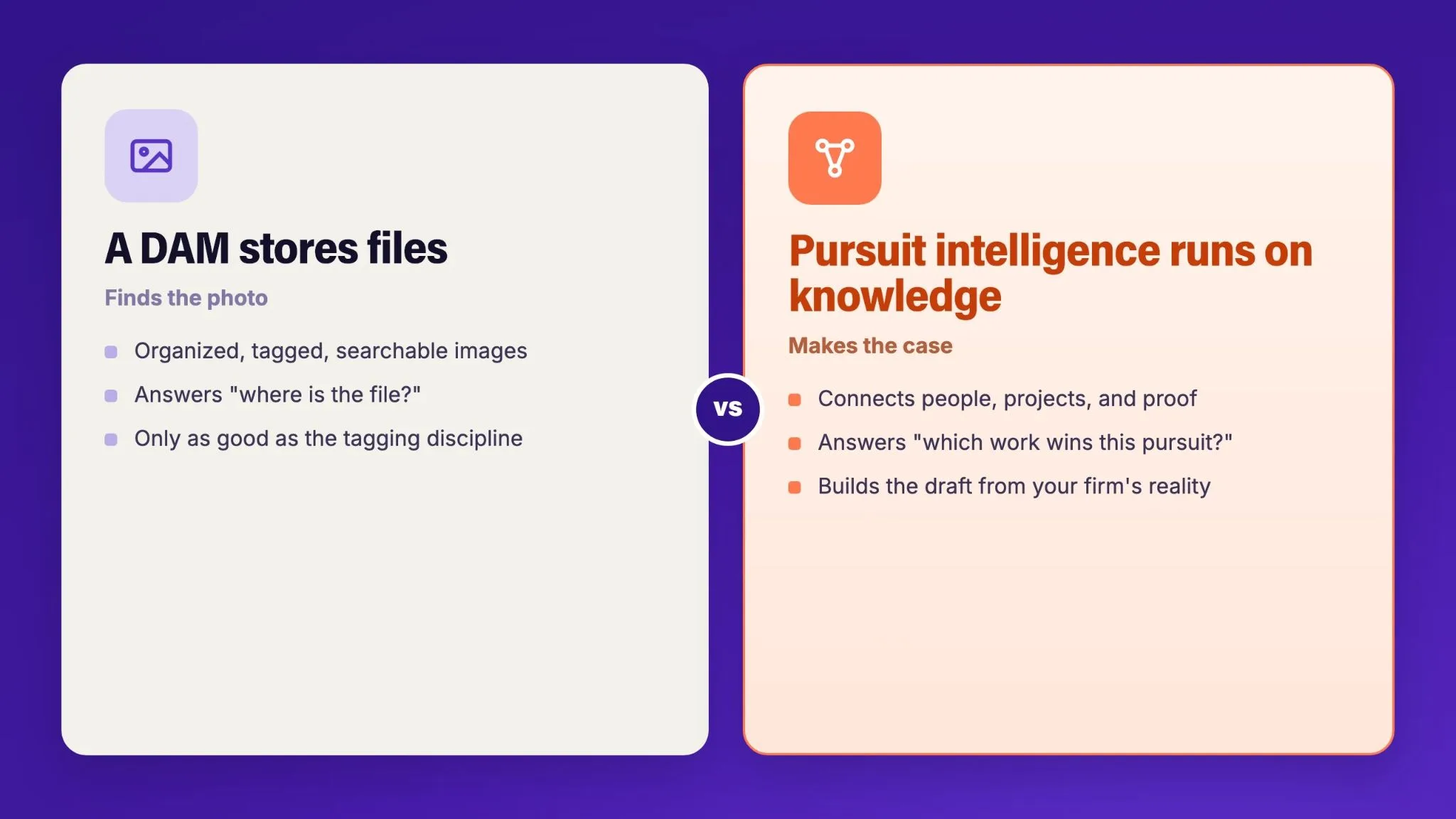
A DAM stores files. A pursuit runs on knowledge.
We've circled this category difference throughout, and it comes down to one thing. A DAM is a filing cabinet with excellent labels. Its essential job is to hold what you put in it and find what you describe.
Kantiv, on the other hand, is built on a knowledge graph. It doesn’t just store files, image intelligence reads the project photography itself, so your team assembles proposals with proven images based on evidence. This means that time spent laboriously maintaining the content library goes away; you get the right image for your pursuit, even if nobody ever tagged it that way. It also shows you details about how many times and in which proposals an image was used, so your team assembles proposals with proven images based on evidence. Retrieval changes from “find me a photo matching these words” to “for this particular pursuit, show me the assets that prove we should win.”
This not only renders traditional DAMs like OpenAsset unnecessary. It fundamentally changes how teams run pursuits.
None of that makes OpenAsset wrong to own. A firm whose real job is a dedicated AEC image library is already using a fine tool.
That is why "we need an alternative to OpenAsset" is usually the wrong frame for what switching firms actually want. Firms that switch DAM-to-DAM keep the same deadline scramble at a different price. Firms that move up to the knowledge layer trade the scramble for a review, and shift their focus to the essential, strategic work that wins pursuits.
Why switching AEC firms land on Kantiv
For firms whose bottleneck is the pursuit itself, Kantiv solves a different problem. It holds your firm's knowledge in that same connected structure, ready the moment a pursuit needs it.
That opens up significant bandwidth for your firm. The hours that went to searching your OpenAsset library go back to win strategy and the go/no-go call. Most of the hours maintaining the library go away, because the graph builds from work the firm already does. The compliance miss that ends a pursuit gets caught before the deadline instead of discovered after. And for firms that are switching off OpenAsset, Kantiv keeps the image side that was working, and adds the usage and coverage-gap analysis on top.
Firms like Robins & Morton cut their award entries from 30 hours to six. Here's their marketing VP's read on where the tool sits now:
"If we tried to get rid of it, we'd have a revolt."
Want to evaluate Kantiv for your firm? Here's what we'd suggest.
- Run the numbers first. The ROI calculator models the return in recovered coordinator hours, so you walk in knowing what the switch would have to earn.
- Book a demo and bring a live pursuit. Comparing against your own RFx beats any feature checklist.
- Ask the questions this comparison raises. Whether the image side covers what OpenAsset does for you today, and how your projects, people, and past performance get connected.
- Get a quote scoped to your firm. Kantiv includes unlimited licenses, so everyone who touches a pursuit can be in the system rather than queuing for a seat.
FAQs
What is the best OpenAsset alternative for AEC firms?
For firms whose bottleneck is pursuits rather than photo storage, Kantiv, because it structures the firm's people, projects, and past performance for winning work. For a pure storage swap, Daminion is the pragmatic pick. For enterprise brand-asset management well beyond AEC project work, Bynder. For stale CVs and credentials specifically, Flowcase is a separate purchase worth knowing about.
Is OpenAsset a DAM?
Yes, a digital asset manager built for AEC, with a newer AI proposal product (Shred) layered on top. Its foundation is an asset library.
Does Kantiv replace OpenAsset?
For most pursuit-driven firms, Kantiv replaces and outperforms a DAM. Kantiv covers the visual use case by reading image content directly, tracking usage across documents, and flagging coverage gaps by market, and the knowledge graph does what a DAM cannot: connect projects, people, and past performance for each pursuit.
How much do OpenAsset alternatives cost?
Pricing across this market is largely quote-based rather than published outright. Daminion is the most transparent about its model: an all-inclusive annual subscription, with AI tagging from $3 per 1,000 images. Bynder, ProjectMark, Flowcase, and Kantiv all quote per deployment, scoped to team size and usage. Factor the coordinator hours saved before comparing sticker prices; the Kantiv pricing and ROI calculator is built for exactly that math.
See how Kantiv surfaces the right past work for a pursuit. Book a demo.
Disclaimer: This comparison was prepared by Kantiv based on publicly available product information and documentation at the time of review. Product features, pricing, plans, and availability may change and may vary by configuration. While we strive to keep this information accurate and current, this comparison may not reflect all available product details. For the most current information, please consult each vendor directly.