Found the content on this page useful? Share it with your team!
Responsive vs. Loopio vs. Kantiv: RFP Software Compared for AEC Firms (2026)

.png)
Table of Contents
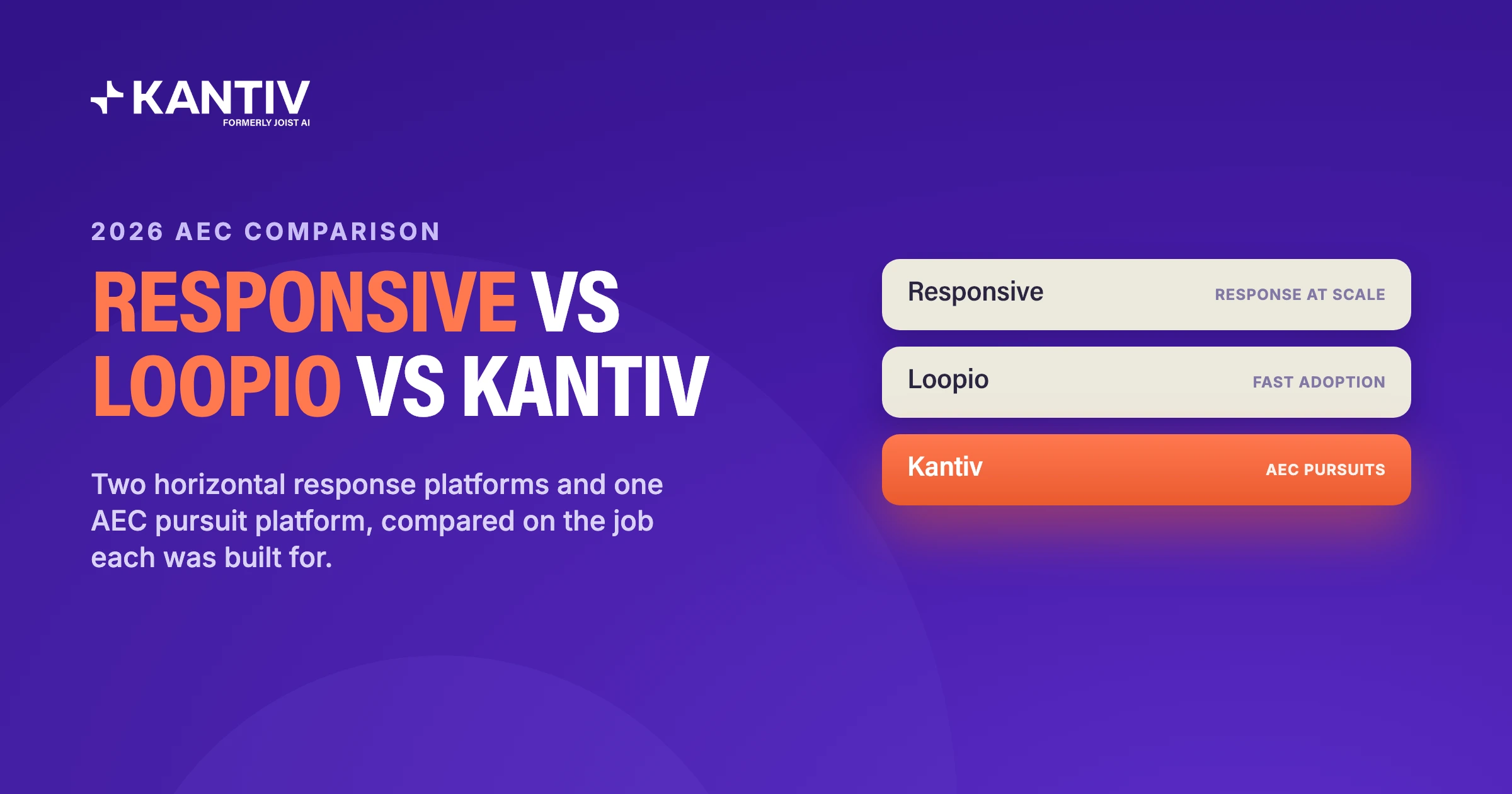
Responsive and Loopio are the two names that come up first when an AEC firm starts looking for RFP software. That’s natural: they're the horizontal category leaders, built for any industry running high-volume RFPs. Especially for teams answering repeated questionnaires, security reviews and DDQs from a shared content library, both are genuinely strong, generating a first draft rather than just retrieving stored answers.
That's where most comparisons stop. The harder question, if you run marketing, proposals or BD at an AEC firm, is whether these tools fit the way your firm actually wins work, and what changes when revenue comes through qualifications rather than through answering the same questions faster.
That’s the question this guide was built to answer. In it, we cover what each tool is genuinely good at, where AEC teams run into limitations, and how to choose the tool that fits your firm.
Responsive vs. Loopio vs. Kantiv, at a glance
If your team answers a steady stream of security questionnaires and sales RFPs, Responsive or Loopio will do that job well.
If your firm wins work through SOQs, SF-330s and shortlist interviews, the evaluation looks different. Kantiv, the pursuit intelligence platform built on your firm’s unique knowledge, is better for that job.
| Best for | What it is underneath | Where AEC teams hit the edge | |
|---|---|---|---|
| Responsive (previously RFPIO) | Enterprise response teams with heavy RFP and questionnaire volume across departments | An AI response-management platform on a shared content library | Horizontal by design. Projects, resumes and qualifications live in it as content rather than as connected records |
| Loopio | Mid-market and enterprise teams answering RFPs, DDQs and security reviews | AI response software on a curated content library | Built for B2B response teams across industries, so AEC document formats are not something it ships with |
| Kantiv | AEC firms that win work on qualifications | Pursuit intelligence on a knowledge graph of your people, projects and past performance | Built for pursuits. If questionnaire volume is the actual workload, a response platform fits that better |
Responsive and Loopio are both strong at the job they were built for. The question this guide answers is narrower. Which job is yours?
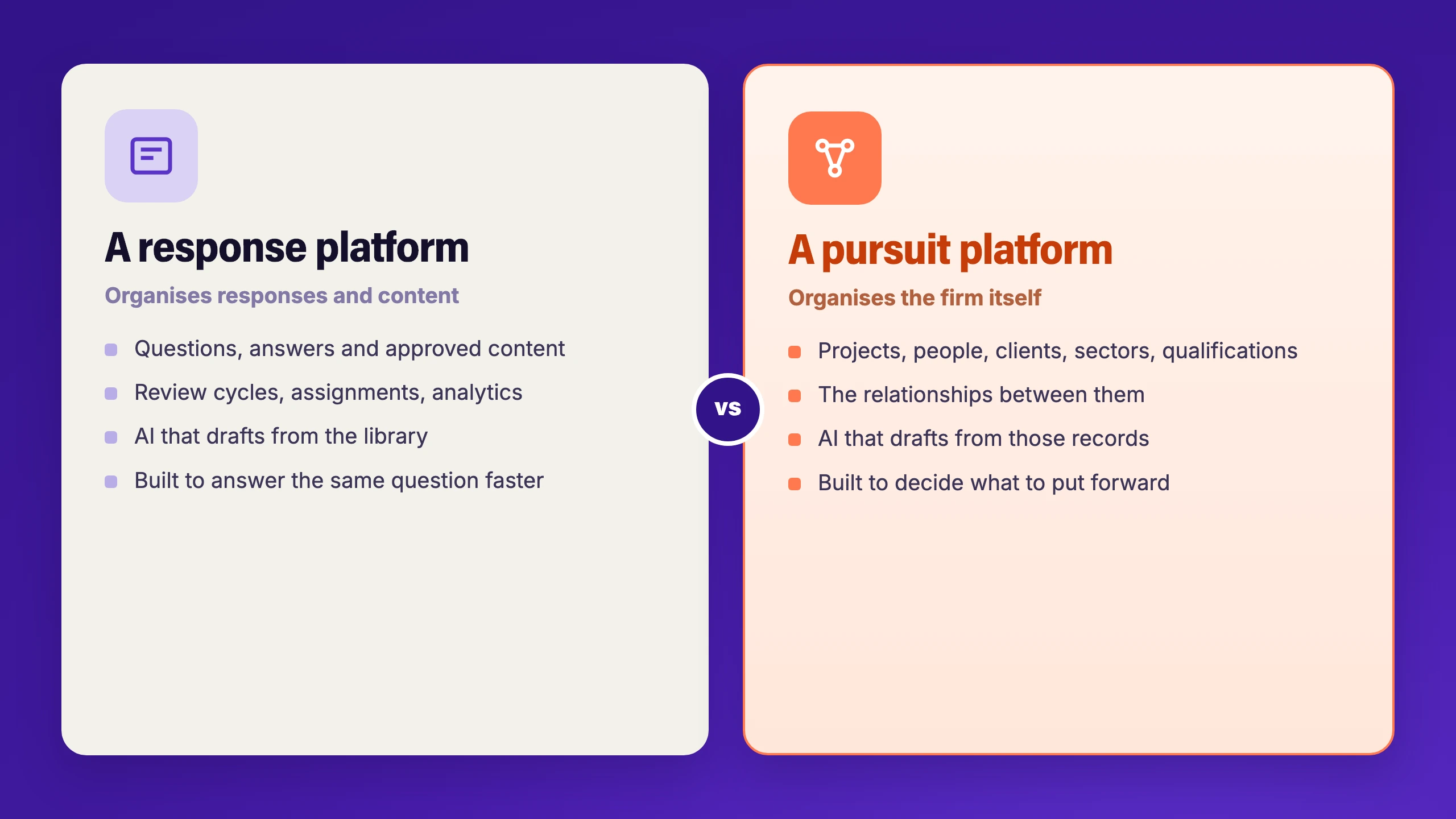
What do Responsive and Loopio actually do?
Both Responsive and Loopio are built around a content library. Your team's approved answers live in one place, each with an owner and a review date. When a questionnaire lands, the AI matches incoming questions against that library.
Both tools, to their credit, have moved well past mere retrieval. Responsive generates personalized first-draft proposals and lets you fine-tune answers from the platform. Loopio drafts from pre-approved content with AI running through the response workflow. Both carry the review cycles, assignments, and analytics that keep a library current.
This suits teams who answer the same questions for a living: sales engineers clearing security questionnaires, IT teams grinding through DDQs, enterprise sales orgs seeing two hundred familiar questions a week in a slightly different order. The second time a question appears, the answer already exists.
The content chaos Loopio and Responsive fix is real everywhere, including AEC. Plenty of firms still run pursuit content out of spreadsheets and a shared drive nobody trusts.
But what kind of content does your firm actually run on? And is a content library the right container for it?
Responsive vs. Loopio vs. Kantiv: the head-to-head
Responsive, Loopio and Kantiv share some similarities when it comes to helping teams draft responses. For AEC firms, though, they diverge sharply, because Kantiv is modeled around the AEC pursuit, not the generic RFP."
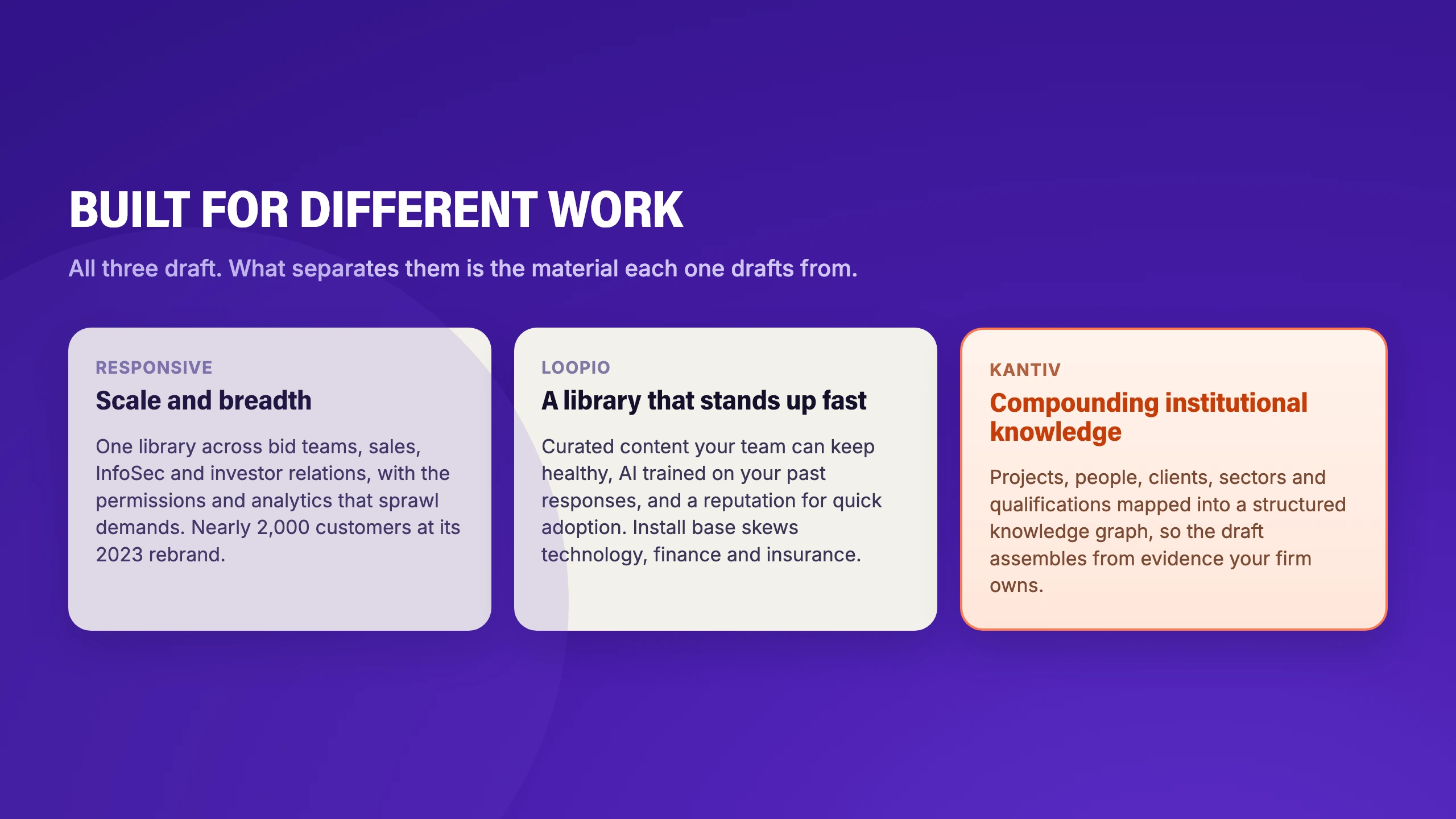
To put it simply: Responsive is built for scale and breadth of response work, while Loopio is built for a disciplined library that stands up quickly. Kantiv sits outside that comparison, because it models the firm itself, and gets smarter with every pursuit you run through it.
Let’s take a deeper look at each platform to see how that distinction plays out.
Responsive (previously RFPIO)
Responsive is the scale play. It runs horizontal RFP response on a shared content library, with reusable answers, questionnaire handling, and the response governance a multi-department rollout demands.
Responsive's own published figures put it at nearly 2,000 customers including more than 20 percent of the Fortune 100, so it leans enterprise, and that shows in both the capability and the implementation. Best for a large response team working across departments.
Loopio
Loopio runs the same play with a different emphasis. It was built for B2B response teams across industries, and its core is a response automation workspace: a content library, smart assignments, automated review cycles, and integrations with CRMs and collaboration tools. The curated model is the point, and the library stays healthy for as long as someone owns it. Best for a mid-market or enterprise team that wants the library working without a long implementation.
Kantiv
Kantiv starts from a different object altogether. Where Responsive and Loopio organize responses, questions, and content, Kantiv organises the relationships between your projects, people, clients, and qualifications, which is what an AEC pursuit actually runs on. That makes it the wrong buy for questionnaire volume and the right one for work won on qualifications.
The real comparison for an AEC buyer
| Criteria | Responsive | Loopio | Kantiv |
|---|---|---|---|
| Content library with AI retrieval | Yes | Yes | Connects & retrieves whole assets: projects, resumes, proof |
| AI first-draft generation | Yes | Yes | Yes, sourced to firm-owned records |
| Security questionnaires and DDQs | Core strength | Core strength | Not the product |
| AEC data model (projects, resumes, qualifications) | Content-level | Content-level | Core, built on it |
| SF-330, SOQ and qualifications workflow | Worth testing | Build it yourself | Native |
| Every answer traceable to a firm-owned source | Library-dependent | Library-dependent | By design |
| Built for | Response at scale across departments | Response, fast adoption | Winning work on qualifications |
How should you choose RFP response software?
For the questionnaire use case, the evaluation criteria are well established. Weigh the following.
- Library health over library size. Most response tools fail when the library gets stale. Ask each vendor how answers get reviewed, expired and re-approved, and who owns that work in practice.
- Answer intelligence. How well does the AI find the right existing content, flag duplicates, and handle a question it has never seen?
- Workflow and integrations. Reviews and approvals need to live where your team already works. For AEC teams, look for integrations with tools like SharePoint, Egnyte, Deltek, Unanet, and InDesign.
- Adoption reality. The best library is the one your seller-doers and subject matter experts actually feed. Reference check with a team your size.
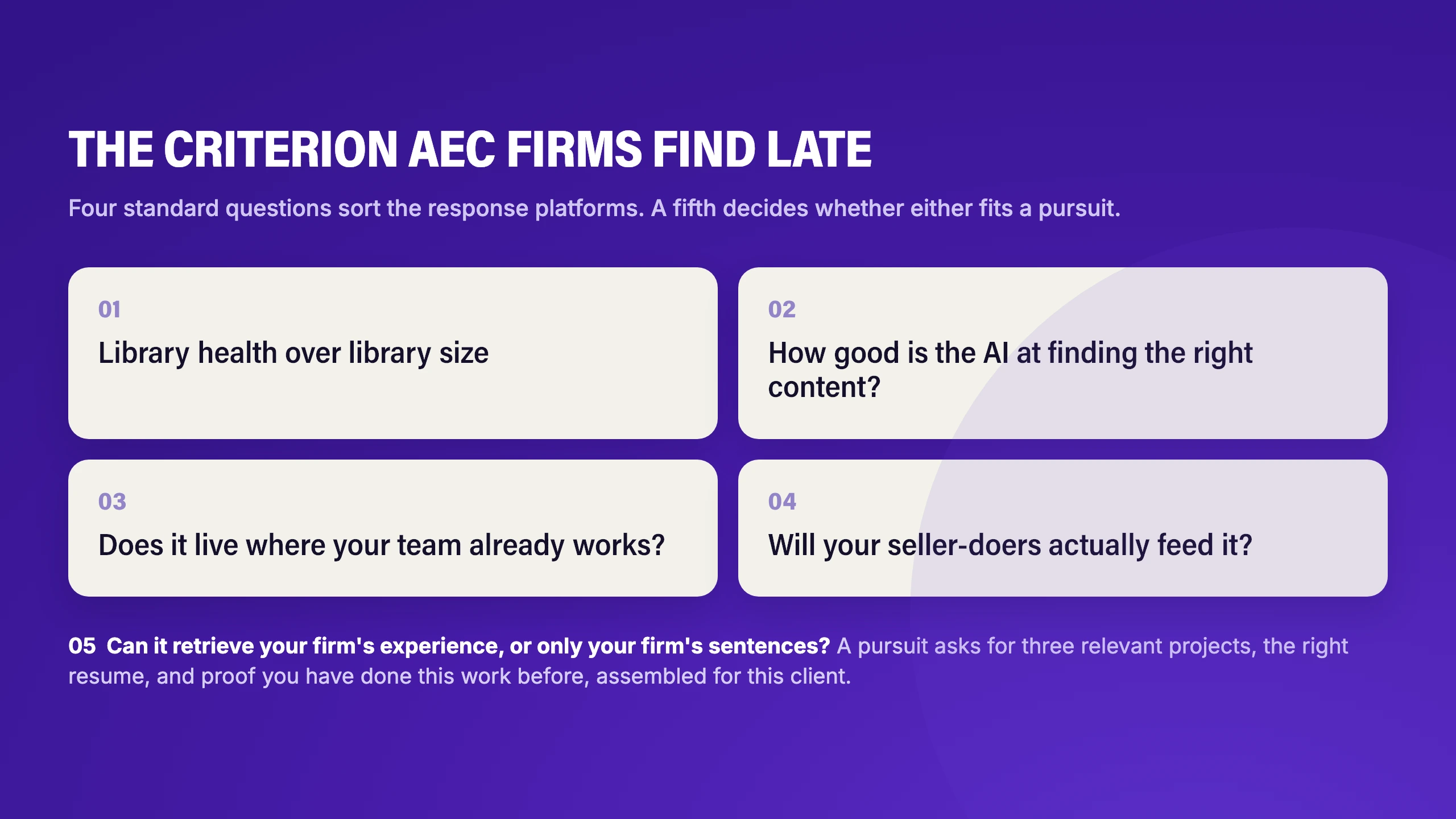
The four above cover most of the evaluation for most buyers.
AEC firms tend to find a fifth one later, usually a few weeks into a pursuit, when the tool has answered every question put to it and still can't tell you which projects belong in Section F: Can it reach your firm's experience, or only your firm's sentences?
You can hear the difference in what teams celebrate once a system is finally working. Stacey Ho, CPSM, of Otak, described that moment on the Marketers Take Flight podcast:
"A lot of people would say, when we got our resumes to pull out of the system perfectly, that is a huge win."
Nobody says that about a well-written answer. The win she's describing is getting the firm's own work back out again, cleanly, at the moment somebody needs it.
Are Responsive or Loopio good for AEC firms?
Both Responsive and Loopio are strong tools, and for an AEC firm with genuine questionnaire volume, either will earn its keep. The harder case is the firm whose revenue comes through qualifications-based selection, where the work these platforms accelerate sits next to the work that actually wins.
Here’s the difference, in a nutshell. A questionnaire has answers, and a content library serves it well. A pursuit makes an argument. Winning one comes down to knowing which of your firm's four hundred projects make the case for this job, and which team, reference, and win story go with it.
Typically, the material that wins pursuits starts as project sheets, resumes, SF-330 sections, SOQ narratives, and past performance data. What you need from software is judgment about which of it fits the pursuit in front of you, and that judgment depends on how the underlying records are structured.
There's a production problem here too, easy to miss because both platforms handle documents well. Templates, branded output, Word and PDF export, images embedded in answers: that's all there.
The gap sits further along. An AEC proposal is a designed document, laid out in InDesign, carrying project photography chosen because it proves something specific to this client. So the useful question for a vendor isn't whether it can hold your images. It's whether it can tell you which image to use, how many times that one has already run this year, and where your coverage is thin before a pursuit exposes it. That's what Kantiv's Image Intelligence does: auto-tagging against projects and clients, usage tracking across proposals, and coverage-gap analysis by market.
Teams that force a library onto pursuit content hit the failure Sreoshy Banerjea, an architect who consults on proposal strategy, described on LinkedIn.
"Going faster has the risk of perpetuating generic boilerplate responses that do not feel customized to the client."
A repository holds what you feed it. Structuring the firm itself is what lets software tell you what to put forward, and that’s how pursuits are won.
What does Kantiv do differently?
Kantiv is a pursuit intelligence platform. The foundation is the Kantiv Knowledge Graph, a living structure of your firm's people, projects, clients and pursuits, extracted from work the firm has already done. Every output traces back to a source your firm owns.
Here's how that changes a pursuit. You upload an RFx, and Kantiv analyzes it and surfaces the most relevant past proposals, project profiles, people and images from your own history. A win strategy pulls your strongest proof points for this client and scope. The first draft assembles from those records, and a compliance check runs against every requirement while there's still time to fix what it finds. Teams work these in whatever order the pursuit demands rather than down a prescribed path.
Firms like Woodard & Curran estimate a time saving of 30 to 40% per proposal, and more than 200 AEC teams run their pursuits this way.
If your team's actual workload is security questionnaires and sales RFPs, buy one of the response platforms above. If your next win depends on assembling the right qualifications quickly from a firm's worth of institutional knowledge, that's what Kantiv is built for.
Which should your firm choose
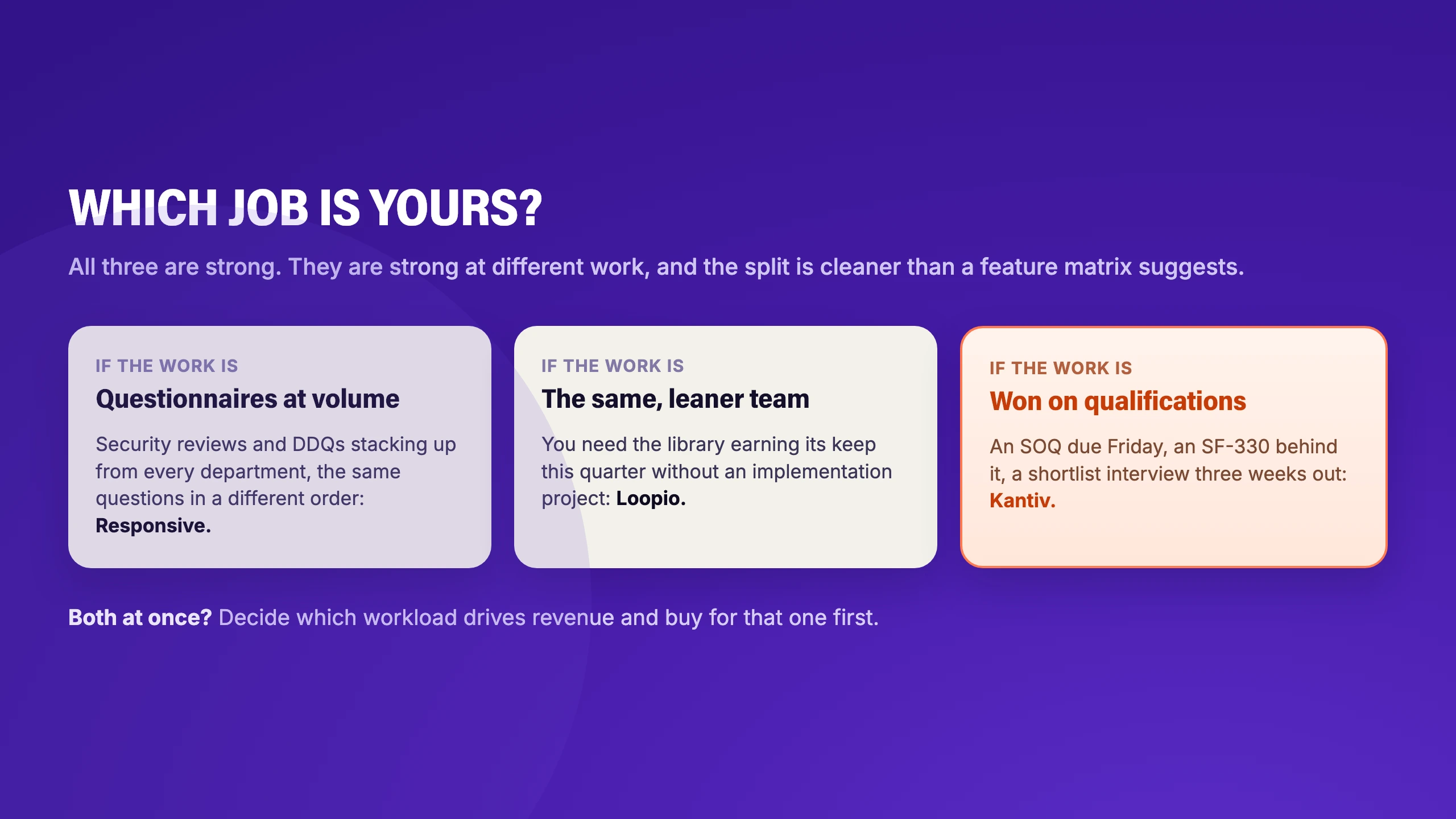
The honest question is which description fits your desk right now.
- Security questionnaires and sales RFPs stacking up from every department? Responsive.
- Same grind, leaner team, and you need the library earning its keep this quarter? Loopio.
- An SOQ due Friday, an SF-330 behind it, and a shortlist interview three weeks out? Kantiv.
If Responsive or Loopio matched your desk, buy accordingly. Both are good at what they do, and this guide isn't trying to talk you out of either.
If it was the last one, the next step isn't a feature walkthrough. Put a live RFx in front of Kantiv and watch which projects, people and past performance come back before anyone starts writing.
FAQs
Is RFPIO the same as Responsive? Yes. RFPIO rebranded to Responsive in 2023. Same product line, new name.
What about first drafts? Both generate drafts. Responsive produces personalized first-draft proposals you then fine-tune; Loopio drafts from your pre-approved content with AI through the response workflow. What changes with Kantiv is the source material: their drafts assemble from stored content, ours from connected project and people records.
How much do Responsive and Loopio cost? Loopio publishes tiered packages, starting with a Foundations plan built around a 10-seat minimum and rising through Enhanced and Enterprise. Responsive quotes per deployment, as does Kantiv. None of the three publish enterprise pricing, so budget conversations start with a demo regardless. The real comparison is fit, not sticker price. For how AEC firms model the return, see the Kantiv’s ROI calculator.
Can we migrate our content library from one to the other? Both support importing existing content, though workflows and approvals rebuild from scratch, so make migration scope a demo question rather than an assumption. Moving to Kantiv works differently: you're ingesting your firm's proposals, projects and resumes so the knowledge graph can structure them.
Is there an RFP tool built specifically for AEC? For the response-library job, the major players are horizontal. For the pursuit job, Kantiv is purpose-built for proposal managers on an AEC data model, with SF-330 and SOQ workflows and integrations to Deltek, SharePoint, Egnyte and InDesign.
Get the pursuit-intelligence platform AEC teams use to win more of the right work. Book a demo.
This comparison was prepared by Kantiv based on publicly available product information and documentation at the time of review. Product features, pricing, plans, and availability may change and may vary by configuration. While we strive to keep this information accurate and current, this comparison may not reflect all available product details. For the most current information, please consult each vendor directly.